


The gut microbiome plays an important role in digestion, metabolism, mental health, and more. Yet when trying to figure out how to improve your gut microbiome, you may stumble upon an overwhelming number of suggestions. Ahead, learn the tried-and-true strategies that can boost gut health.
Last year, I started experiencing cramping and bloating that would show up without warning. They made everyday life uncomfortable and got in the way of hobbies I love, like running and going on hikes. These symptoms also bothered me because I do everything”right” for my health: I work out five times a week, eat primarily whole foods, and always get eight hours of sleep. So I began researching how to improve the gut microbiome, and what I learned surprised me.
Many hidden factors, such as stress or not eating a diverse enough diet, can harm the gut microbiome, even if your lifestyle is healthy overall. The flipside is encouraging: Many small changes can improve gut health, either on their own or paired with insight from a GI provider when symptoms are more severe.
If your gut has been acting up lately or you’re looking to improve the gut microbiome in general, you’re in the right place. Ahead, we’re going to discuss evidence-backed strategies related to diet, stress management, and more that can boost gut health.
What the gut microbiome is and why it matters
Before we get into how to improve gut health, we should probably define what the microbiome is. The term”gut microbiome” sounds like a complicated phrase from your high school biology class, but you can think of it as a forest.
“Like a forest has thousands of different plants and animals with their own unique functions, so does the microbiome,” says Masha Sardari, RDN, registered dietitian nutritionist and founder of Fearlessly Nourished.
While the forest near your house may have deer, squirrels, raccoons, geese, and more, the gut microbiome contains microbes. According to the National Institute on Aging, those microbes include bacteria, viruses, fungi, and other microorganisms. The institute estimates there are trillions of these microbes, which is admittedly a lot more than the species in most forests.
If the terms bacteria, viruses, fungi, and microorganisms made you shudder, I get it. We’re often taught to label these things as always bad, but it turns out there’s a mix of good, neutral, and bad microbes in the gut. These microbes play an active role in many biological processes:
- Digestion: Gut microbes help the body digest food and absorb important nutrients, per a 2022 BMJ review.
- Immune System: 70-80% of immune cells are located in the gut, per a 2021 Nutrients review. That means the immune system is highly dependent on the type of gut microbes, with beneficial microbes associated with a stronger immune system and harmful microbes with a weaker one.
- Mental Health: The gut microbiome has a direct impact on mental health. There’s actually a physical connection between the two, known as the gut-brain axis. The gut and brain communicate bidirectionally through this axis, and a 2025 meta-review in Cureus linked good gut microbes to improved mental health.
- Metabolism: Metabolism refers to the biological processes that turn food into usable energy. While a “good” metabolism is often associated with a healthy weight, metabolism does so much more, too. It helps boost energy levels, regulate body temperature, and helps our body move. A 2026 Gut Microbes article states that the gut microbiome is an important regulator of metabolic health.
Defining a healthy gut microbiome
There aren’t standard definitions of what counts as a”healthy” or”unhealthy” gut microbiome, according to a 2025 article in the Journal of Clinical Investigation. What we do know is that some microbes tend to be beneficial to gut health and overall well-being, while others are neutral or harmful.
Certain factors influence the ratio of good-to-bad gut microbes. A 2024 BMJ paper divided up elements that influence that balance into a few categories:
- Diet
- Environmental
- Lifestyle
- Host
The paper’s fourth category, host, refers to the role genetics and underlying conditions, such as GERD or Crohn’s disease, may play in influencing what someone’s gut microbiome looks like. This one is not modifiable, but the other three can be.
How to increase good bacteria in the gut naturally
There are many steps you can take to maintain or increase good bacteria in the microbiome. When looking into how to increase good bacteria in the gut naturally, you don’t need to completely overhaul your life. Little tweaks to diet and lifestyle can make a huge difference.
Build a microbiome diet around plant variety and fiber
First up: Diet. This one might seem obvious, but defining a healthy diet isn’t as easy. Fortunately, there are a few guiding principles that can help you design a gut-friendly diet.
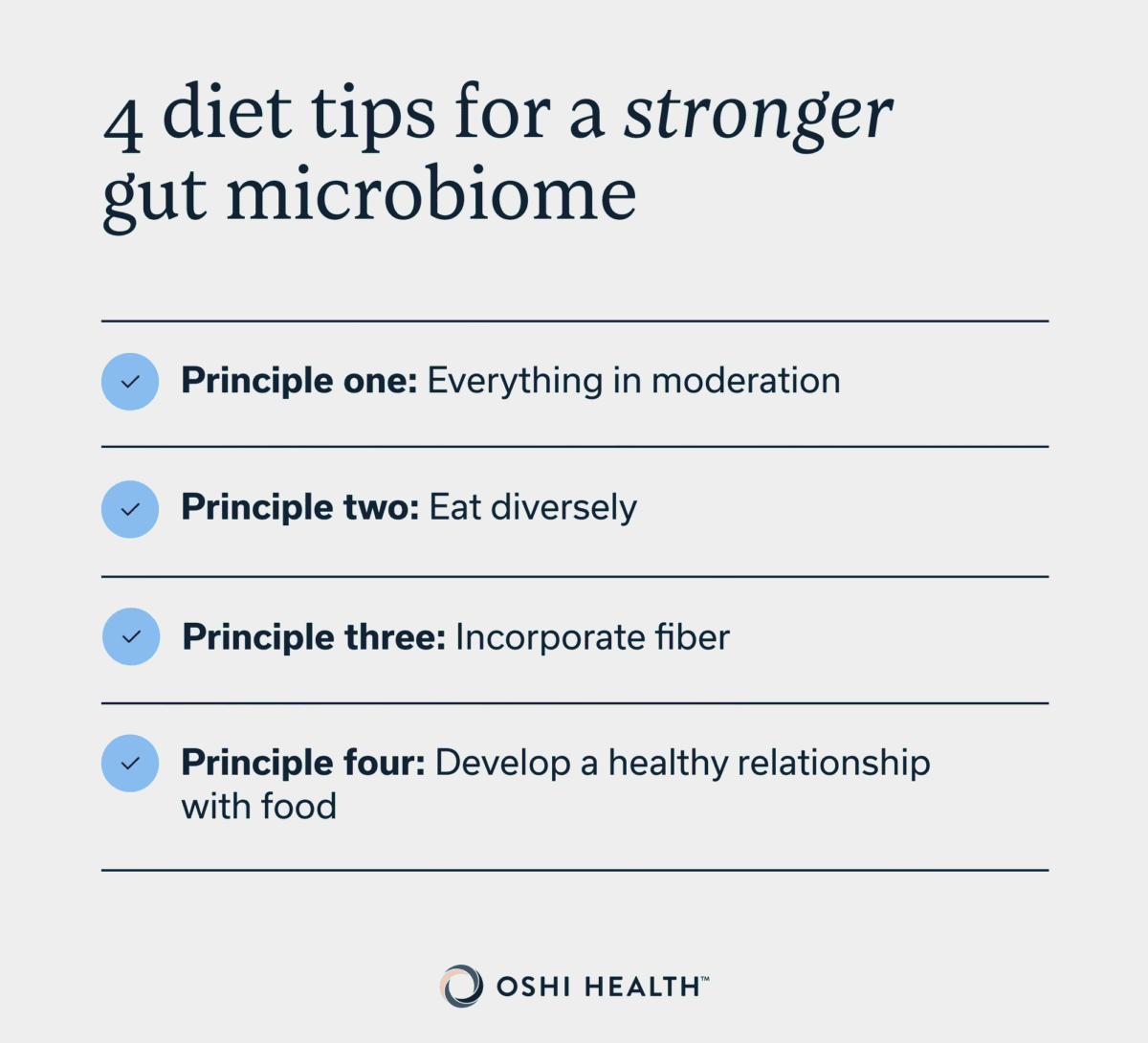
Principle one: Everything in moderation
Nutrition is confusing because a single food or drink can be healthy or harmful, depending on how much you consume. Take coffee, for example. A 2026 study in Nature found that participants who were coffee drinkers had a healthier gut microbiome than those who didn’t. While this makes my coffee-obsessed self happy, a 2024 study in Nutrients cautioned that more than five cups a day was associated with a progression in Crohn’s disease, increased acid reflux, and other adverse gut health effects.
This demonstrates a key guideline for a microbiome diet: Everything in moderation. Too much of a good thing can be a bad thing for our gut health.
Principle two: Eat diversely
Moderation makes way for the second principle: Eat a varied diet. A 2022 paper in the International Journal of Molecular Sciences defined a robust gut microbiome as one with a variety of different types of good and neutral gut bacteria. One way to promote that diversity? Eat a variety of gut-friendly foods, such as:
- Fruits
- Legumes (i.e. lentils, beans, chickpeas)
- Nuts and seeds
- Veggies
- Whole grains (i.e., whole grain pasta, brown rice, quinoa)
Principle three: Incorporate fiber
A particular carbohydrate that’s beneficial for gut health is fiber. According to the CDC, fiber helps keep us full for longer and cleans out the digestive tract. Almost all the food groups above include sources of fiber.
To give you an idea of just how many different whole foods contain fiber, here are some examples:
- Almonds
- Black beans
- Brown rice
- Lima beans
- Oranges
- Quinoa
- Raspberries
- Spinach
- Whole-wheat pastas
While fiber is great, some caution is needed here. GI experts recommend slowly integrating more of it into your diet to avoid uncomfortable GI symptoms and to give your body time to adjust. If you already have chronic (ongoing) GI symptoms or have been diagnosed with a GI condition, work with a registered dietitian to determine the appropriate types of fiber and suitable ways to incorporate them into your diet. And remember, one type of food might not be beneficial for everyone.
Principle four: Develop a healthy relationship with food
Eating an ultra-restrictive diet or avoiding all unhealthy foods (such as French fries, ice cream, and pastries) may sound good in theory, but it’s not likely to lead to sustainable gut health. Instead of following an extreme diet or beating yourself up when you eat something”wrong,” Sardari recommends developing or maintaining a healthy relationship with food.
To fully understand why this matters, we have to take it back to the gut-brain axis. This pathway is bidirectional, meaning messages flow both ways. If we’re in a negative or stressed state due to food, it may lead to more pro-inflammatory species of microbes in the gut microbiome.
“By fostering a positive relationship with food,” Sardari explains, “We can decrease the level of worry and fear around foods, which in turn may result in less pro-inflammatory and more beneficial gut bacteria.”
To do so, she recommends practicing intuitive eating. Per a 2024 article in Eating Behaviors, intuitive eating is listening to the body’s physiological signals, such as a grumbling stomach. It means eating when hungry and stopping when full. Intuitive eating is easier said than done, and many people find it helpful to unpack their relationship with food with a gut-brain specialist or therapist in order to successfully practice intuitive eating.
Support gut health with everyday lifestyle habits
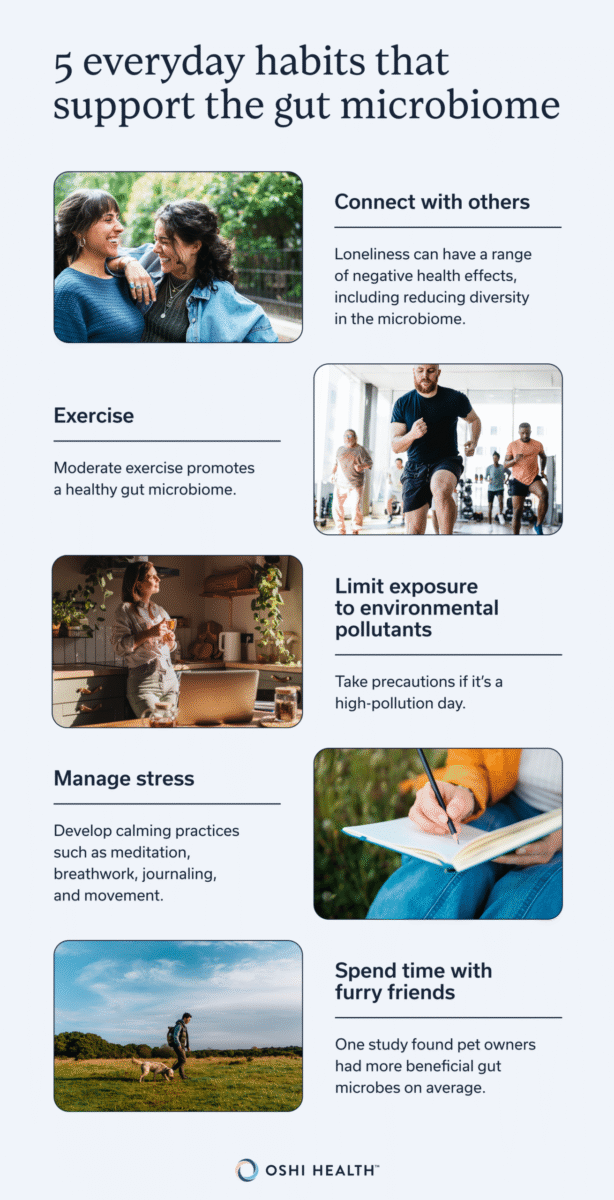
Lifestyle habits and environment impact gut health too. Some ones that may help improve the gut microbiome include:
- Connect with others: Loneliness can have a range of negative health impacts, including reducing diversity in the microbiome, per a 2021 paper in Frontiers in Psychiatry. That means your next date night, family reunion, or afternoon spent with friends may actually improve your gut health.
- Exercise: According to a 2024 paper in Nutrients, moderate exercise promotes a healthy gut microbiome. Defining what moderate physical activity looks like isn’t easy, but a good rule of thumb is to meet or exceed the CDC’s exercise guidelines (two strength training sessions a week and 150 minutes of mild-to-moderate aerobic exercise).
- Limit exposure to environmental pollutants: Environmental pollutants can impact the gut microbiome, per a paper in Biofilms and Microbiomes. These pollutants could be found in the air or in everyday household items. That’s why it’s important to buy quality products and to take precautions if it’s a high-pollution day, such as keeping the windows closed inside the house and when driving if your area is full of smoke from a wildfire.
- Manage stress: A 2023 paper in The Journal of Physiology suggests that stress negatively impacts the gut microbiome. While we can’t 100% reduce all stress in our lives, we can develop practices to manage it better, such as meditation, breathwork, journaling, and calming movement (think: yoga, walking, swimming).
- Spend time with furry friends: “Even whether you own a pet can contribute to the health of the gut microbiome,” says Sardari. In fact, a 2021 study in Animals found pet owners had more beneficial gut microbes on average compared to people who didn’t own a pet.
Successfully implementing gut-friendly changes
Supporting gut health is kinda like adulting. There are a lot of different things to think about, and it always feels like you could be doing more. But trying to do it all is a recipe for exhaustion and giving up.
Instead of adopting all these strategies at once, choose one to three that are manageable and make sense for your lifestyle. If you already own a dog, for example, taking one more walk with them a day may be a manageable way to keep your gut (and puppy) happy. But if you aren’t already a pet owner, adopting one might not be the easiest tip to implement.
Should you take a probiotic or prebiotic supplement?
You probably noticed probiotics and prebiotic supplements weren’t on our gut-friendly list. According to the National Institutes of Health, probiotics are beneficial microorganisms for the gut. Prebiotics are basically a fertilizer for probiotics; they provide what probiotics need to grow, per a 2024 Foods article.
Both can be consumed through a healthy diet, but some people find it beneficial to get one or both from a supplement. Probiotic supplements have demonstrated benefits for gastrointestinal health, but the exact impact depends on the strain and the individual. Sardari explains, “The same probiotics can result in different effects from person to person, depending on their individual gut microbiota.”
The same goes for prebiotics. In the studies reviewed in a 2024 meta-analysis in Gut Microbes, prebiotics generally had a positive impact on health. But again, the supplement’s effects depended on the ingredients and factors unique to each study participant, such as whether they had a GI condition.
If interested in a prebiotic and/or probiotic supplement, consult a GI provider or registered dietitian to learn if they are appropriate in your case and possibly to get a recommendation on reputable brands.

Common mistakes when trying to fix gut health
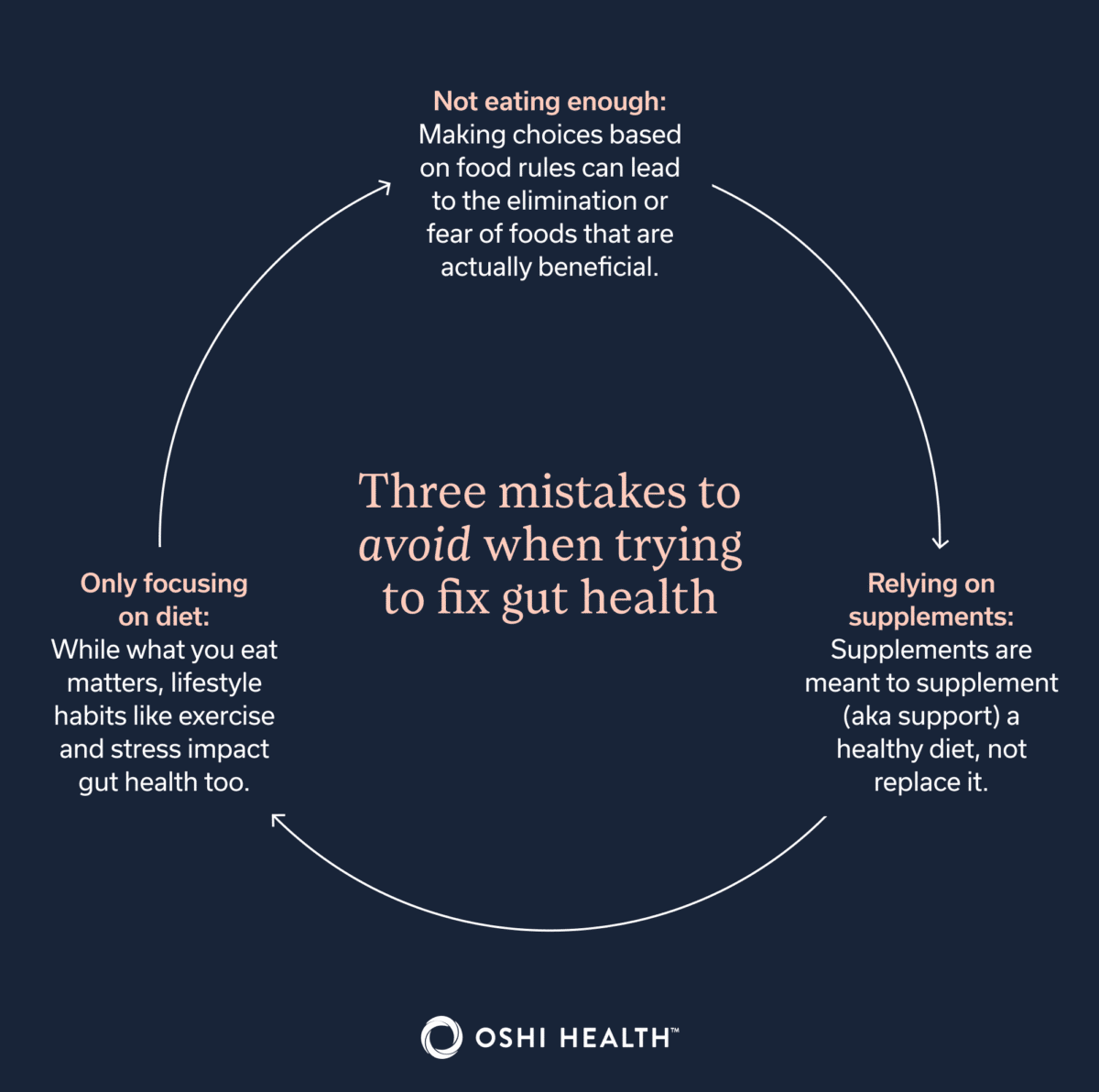
If you research how to improve gut microbiome online, you’ll find plenty of advice, some of it good…and some of it not so much. Sardari outlines some of the most common mistakes she sees in her practice:
- Not eating enough: “With increased restriction, there is a more limited range of foods,” Sardari explains, “and making choices based on food rules can often lead to the elimination or fear of foods that are actually beneficial to the gut microbiome.”
- Relying on supplements: The name itself gives away their purpose. Supplements are meant to supplement (aka support) a healthy diet, not replace it.
- Only focusing on diet: While what you eat matters for gut health, it isn’t the be-all, end-all. Lifestyle habits, exercise, stress levels, and more impact gut health too.
Can you test the health of your gut microbiome?
While no single test can determine the gut microbiome’s health status, GI providers often order a few different tests to gather clues on what’s going on in the gut. Those tests include:
- Blood tests: Blood tests can be used to assess a variety of health markers, such as inflammation in the body, blood count, cholesterol levels, and more, per the National Heart, Lung, and Blood Institute.
- Breath tests: These measure certain gases, such as hydrogen and methane, that can be created in the gut and then are exhaled. They are especially helpful in diagnosing intestinal methanogen overgrowth (IMO) and small intestinal bacterial overgrowth (SIBO), per a 2023 paper in Gastroenterology and Hepatology.
- Endoscopic tests: An endoscopic test is when a GI provider inserts a tube with a camera into the digestive system. The most commonly known of these tests is a colonoscopy.
- Imaging tests: X-rays, MRIs, CT scans, and ultrasounds can provide imagery of what the gut looks like on the inside. They may be used in the diagnosis of a variety of GI conditions.
- Stool tests: These tests are often used to detect blood or mucus in someone’s stool, according to the CDC. They may be used for other reasons too, but these are two of the most common, especially when ordered to assess gut health.
At-home tests may also be able to assess the gut microbiome. If you opt for an at-home test, though, make sure you discuss the options with your provider. Afterward, share any results with them so they can incorporate the results in the context of your overall treatment plan.

Personalize your plan when gut symptoms are present
Raise your hand if you’ve ever created a perfect plan, only for it to be impossible to follow through. That’s happened to me more times than I care to admit, and the truth is no plan can be 100% flawless. Life happens, which sometimes includes unpredictable gut symptoms.
If you experience bloating, pain, stool changes, heartburn, nausea, or other symptoms, personalize any or all of the suggestions above so they suit your health and lifestyle.
To do so, consider:
- Track any triggers: Jot down whenever gut symptoms occur in the Notes app on your phone, such as if your bowel movements change whenever you feel stressed or you always experience heartburn after eating spicy foods.
- Ask a GI provider: They can offer modifications specific to your GI conditions and symptoms.
- Seek GI care: If you don’t already know what’s causing GI symptoms, visit a GI provider, such as the team at Oshi Health. They can diagnose the underlying cause and recommend a treatment plan.
- Practice self-compassion: It can be so easy to beat yourself up when abdominal pain makes it hard to finish a workout or you stay home from a meetup with friends due to having too many bowel movements. When GI symptoms get in the way, don’t beat yourself up. Instead, practice self-compassion and appreciate what you can do.

Cari shares her experience with Oshi Health.
When to seek care
“If symptoms worsen, do not improve with reasonable changes, or there is potential for an underlying condition, seeking GI care is recommended,” says Sardari. If you’re wondering what symptoms merit medical attention, here are some of the most common:
- Bloating or abdominal pain that recurs or interferes with daily life
- Bowel movement changes that are ongoing for weeks or months
- Burning sensation in chest that keeps popping up
- Inability to keep food down
- Persistent fatigue
- Sudden or significant changes in bowel habits
- Vomiting or nausea
Seek immediate medical attention if experiencing:
- Significant amounts of blood in stool
- Fever alongside GI symptoms
- Ongoing diarrhea
- Persistent vomiting
- Severe abdominal pain that makes it hard to get up from bed or move around

The bottom line
The gut microbiome houses trillions of microbes, some of which support our health and others that don’t. The ratio of good-to-bad microbes isn’t set, and the decisions you make every day influence that balance. For those with a GI condition or people who have unexplained GI symptoms, like bloating or bowel movement changes, working with a GI provider, such as Oshi Health, may be part of tipping the scale back in favor of the beneficial microbes.
Frequently asked questions (FAQs)
-
Improving the gut microbiome isn’t a sprint. Instead, it’s better to think of the gut microbiome as a long-term project, per UCLA Health. That project doesn’t have to consume your entire day, but it often involves taking small, consistent steps toward better gut health. This could look like going on an evening walk, eating nuts as a snack at work, and practicing breathwork to calm the gut-brain connection.
-
There isn’t one food that will permanently improve or worsen your gut microbiome. The health of the gut microbiome is determined through long-term dietary habits, such as consistently eating more healthy foods than unhealthy ones, eating a diversity of foods, and feeding your body enough food for it to function day in and out.
-
If looking at how to fix gut health, coffee might play a helpful role. According to a 2026 study in Nature, coffee drinkers have more beneficial gut microbes than those who don’t drink coffee. However, if you have a sensitive stomach or an underlying GI condition, drinking too much coffee may lead to more bowel movements and possibly other GI symptoms, such as stomach cramps and bloating.
Ready to better understand your gut microbiome?
Your gut microbiome plays an important role in digestive health, but knowing how to actually support it can feel overwhelming—especially when you’re dealing with symptoms like bloating or constipation.
Oshi Health’s GI providers, gut-brain specialists, and registered dietitians take a whole-person approach to digestive health, helping you understand your symptoms and build a plan that supports your gut and your microbiome.
With Oshi, you’ll get:
✔ Personalized guidance based on your symptoms, lifestyle, and goals
✔ Science-backed strategies to support a healthy gut microbiome
✔ Nutrition guidance without unnecessary food restrictions
✔ Compassionate, whole-person GI care
✔ And so much more!
Ready to give your gut the support it deserves?