



Ever find yourself asking, “Why do my farts smell so bad?” Stinky farts hit us all from time to time, but if they’re happening more than usual, it may be due to a diet-related change or gastrointestinal (GI) condition. Here’s how to determine what’s causing the smell.
You’re in the middle of a workout class when all of a sudden, the studio starts to smell. You know the reason why, but you’re praying no one else discovers it. Smelly farts almost always seem to happen at the worst time, whether it’s during a sweat sesh, on a first date, or right before that big work presentation. They can leave us feeling mortified, silently asking, “Why do my farts smell so bad?”
We all fall victim to farts that smell. But if the stench has been extra strong lately or you’re farting more than usual, there could be an underlying reason. It could be something temporary, such as eating a few more beans than usual, or a sign of an underlying gastrointestinal condition.
Telling the difference, however, can be even more frustrating than farting in a quiet room. Here are the many reasons the smell may be stronger (or the farts more frequent), along with some easy at-home steps that can help.
What causes farts to smell?
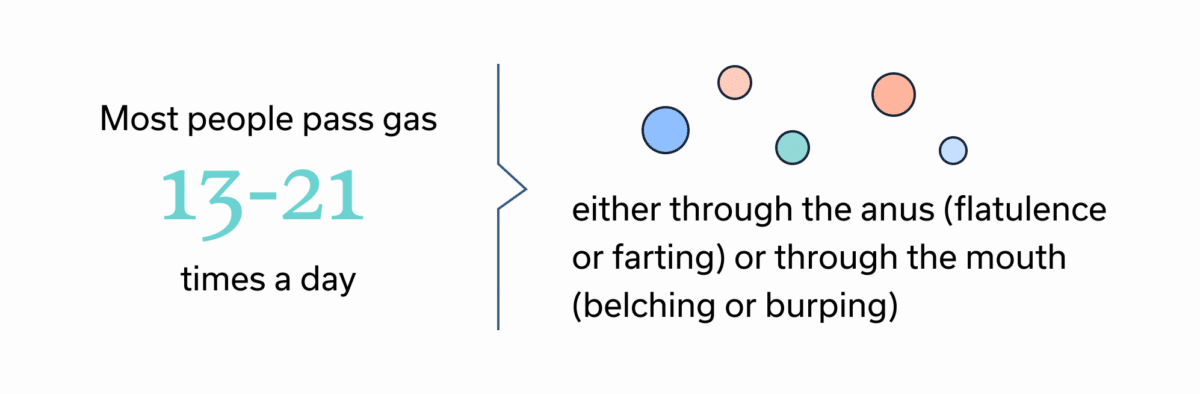
While farts are the brunt of many jokes, they’re nothing to be embarrassed about. In fact, most people pass gas 13 to 21 times a day, either through the anus, which is called flatulence or farting, or through the mouth, which is referred to as belching or burping.
During the digestive process, gas builds up due to air swallowed when eating, certain foods, carbonated beverages, and the process of bacteria breaking down undigested food in the large intestine. That gas isn’t useful, so the body expels it via the mouth or anus.
Usually, there isn’t a smell when we pass gas. If the odor is a one-off experience, it could be due to eating certain foods. When the smell is recurring or you find yourself asking, “Why do my farts smell so bad all of a sudden?” it could be something else, whether a case of constipation or an underlying chronic GI condition.
“If the root cause is related to diet or constipation, small dietary and lifestyle changes can be made to improve symptoms,” says Katrina Cox, MS, RD, a registered dietitian specializing in IBS and SIBO. “However, if those changes don’t make improvements in your gas, then it is important that you look deeper.”
Everyday reasons your farts might smell bad all of a sudden
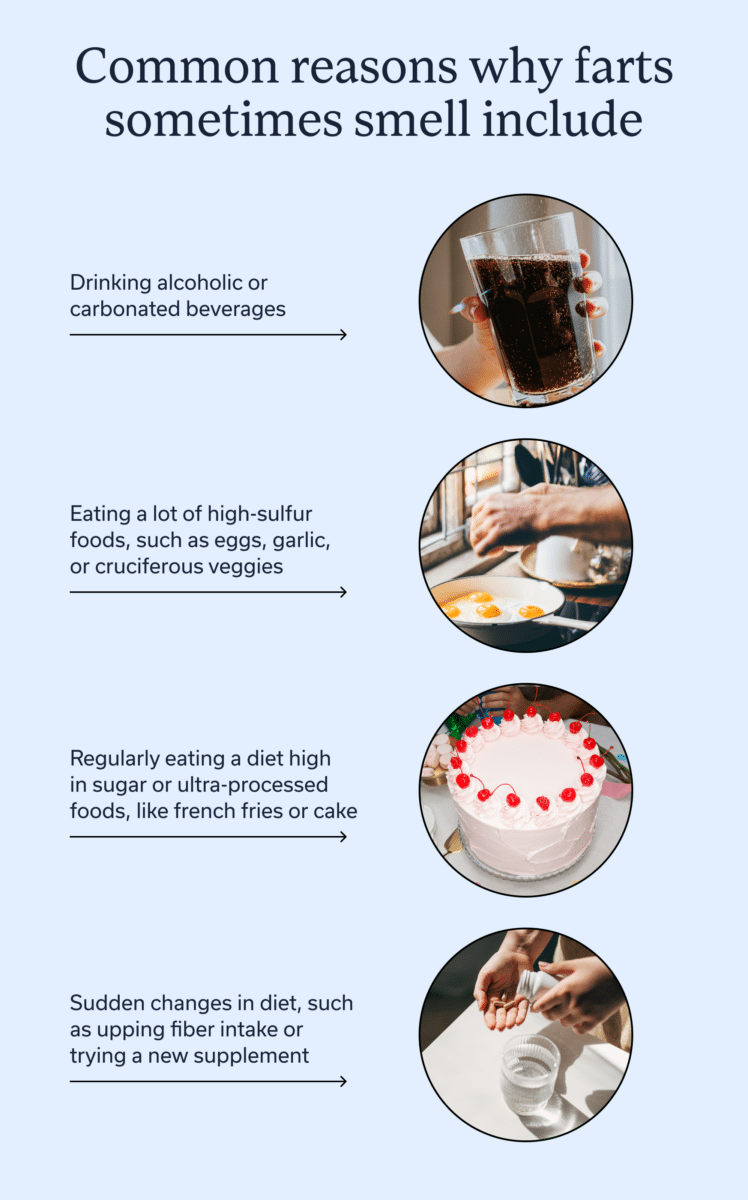
The answer to the question”why do farts smell?” is usually an everyday, harmless habit. That’s why everyone produces smelly farts from time to time. Common reasons why farts sometimes smell include:
- Eating a lot of high-sulfur foods, such as eggs, garlic, or cruciferous veggies
- Eating quickly, causing you to inhale more air while eating (causes increased gas but is not necessarily linked to smell)
- Regularly eating a diet high in sugar or ultra-processed foods, like French fries or cake
Most of these everyday reasons aren’t a cause for concern. If you add more fiber to your diet or have the occasional soda and your farts smell, it may just be a normal reaction. In some cases, the smelly farts will go away on their own. In others, you might need to make a few tweaks to your diet (which a registered dietitian can help with)
But if you (or worse, someone you live with) notice that your farts are suddenly smelling particularly bad, the reason is likely a change to your routine or diet. Common culprits include:
- Adding more ultra-processed foods or sugar to your plate than you typically do
- Eating a diet that is high in animal protein and low in fiber
- Traveling, especially if it involves eating differently than usual
- Sudden changes in diet, such as upping fiber intake or trying a new supplement
But beware: Sudden stinky farts may also stem from a recent GI infection, like a stomach bug or food poisoning. When this is the case, there are almost always other symptoms, such as nausea or diarrhea.
When smelly farts point to an underlying digestive condition
If the smelly farts don’t go away after a few weeks, they may be due to a GI condition that’s causing changes to the digestive system. Medical conditions that can cause smelly farts are:
- Celiac disease: This is when the small intestine cannot process gluten, and there’s damage to the small intestine. With Celiac disease, someone may pass more gas after eating gluten.
- Constipation: Constipation is the sensation of needing to poop but not being able to, and it can be either acute or chronic. “This is the most common reason for smelly gas,” says Cox, “The reason for this is because the longer the stool is sitting in your intestines, the more it ferments, leading to a smellier gas.”
- Chronic pancreatitis: This condition occurs when there’s persistent inflammation of the pancreas from digestive enzymes. It may cause smelly farts, among other GI symptoms.
- Inflammatory bowel disease (IBD): IBD is a group of autoimmune diseases that affects the intestines and bowels. The two most common forms are Crohn’s disease and ulcerative colitis. IBD’s changes to digestion and the increased inflammation can change the odor of flatulence.
- Irritable bowel syndrome (IBS): IBS is a common condition where someone’s small intestine and colon are more sensitive to normal GI functions. “If you have IBS, FODMAPS (a group of small-chain carbohydrates that are undigested and highly fermentable) can lead to symptoms such as foul-smelling gas, bloating, and changes in bowel movements,” says Cox. High FODMAP foods include, but are not limited to, apples, broccoli, beans, pastries, and cashews.
- Lactose intolerance: This condition occurs when someone has trouble digesting dairy products, like milk or cheese. It can develop at any point and often leads to GI symptoms like passing more gas than usual or bloating.
- Non-celiac gluten sensitivity: When someone is sensitive to gluten, they may pass more gas when they eat foods that contain it. Unlike celiac disease, this type of gluten sensitivity doesn’t cause damage to the small intestine.
- Other food intolerances: If the body has trouble digesting certain foods, like fructose or certain carbs, someone may also experience more gas than usual.
- Small intestinal bacterial overgrowth (SIBO): “Small intestinal bacterial overgrowth is a big reason why your gas may be extra stinky,” says Cox. SIBO occurs when there’s an overgrowth of bacteria in the small intestine. This can lead to various GI symptoms, including flatulence with an odor.
For each of these, smelly farts most likely won’t be the only symptom. They’re also not self-diagnosable. Instead, a GI specialist, such as the team at Oshi Health, would have to assess symptoms and diagnose what’s happening.

Diagnosis and testing: How a healthcare provider investigates smelly gas
A healthcare provider will investigate smelly gas by first asking you questions about symptom severity and when they occur. They’ll also ask about bowel habits, weight changes, medications you take, and if there’s a family history of any GI conditions.
From there, your provider will complete a physical exam and may order bloodwork or stool tests for specific conditions they suspect. Most of the time, a diagnosis can be made without an invasive test (like a colonoscopy), but a GI provider can walk you through what needs to be done.
Evidence-based ways to reduce smelly farts at home
The best approach to flatulence that impacts someone’s quality of life is often structured, individualized, and involves multiple treatments. Your gut doesn’t exist in a vacuum–it impacts your mental health, immune system, how you feel in social situations, and so much more. Any GI treatment plan should tackle it from multiple angles, too.
With the help of a GI specialist, you can decide on the best”quick fixes” for smelly farts. Some of those may include:
- Add in fiber (slowly): “The first thing that you want to do is make sure you are having complete and satisfying bowel movements by slowly adding gentle fiber to your diet,” says Cox. With fiber, you want to add it in slowly (and ideally under the guidance of an RD if you’re experiencing GI symptoms).
- Consider medication: Use over-the-counter products that help with gas, but only under the supervision of a GI specialist.
- Enjoy certain foods in moderation: Space out high-sulfur foods, ultra-processed foods, and sugary foods so you don’t eat too many in a single day or meal.
- Gentle movement: Exercise regularly, especially gentle movement that aids digestion. More extreme workouts might shake things up too much when gassy (I’m looking at you, running and burpees).
- Hydration: Drinking enough water since hydration aids smooth digestion, which may lead to less gas.
- Try peppermint tea: “One of my favorite fixes to excessive gas is peppermint tea,” says Cox, “It helps with trapped gas and moves things along.”
Other changes, such as following the FODMAP diet or cutting out another food group, should not be completed on your own. They’re most effective under the guidance of a GI specialist, who may be able to provide insight into how to customize the tips above, too.
When to seek care
If smelly gas lasts for a couple of weeks, especially if it’s accompanied by additional GI symptoms (diarrhea, abdominal pain, bloating, etc.), seek medical attention. Start with an appointment with your primary care provider, who may refer you to a GI specialist—or, you can head straight to that GI provider.
Seek immediate medical attention if also experiencing smelly gas with:
- Black or tarry stools
- Blood in stool
- Extreme abdominal pain or cramping
- High fever (102 degrees or higher)
- Mucus in stool
Working with an Oshi Health provider
No matter what’s causing your smelly farts, a GI provider can help connect the dots. They can pinpoint the exact cause, map out any dietary or lifestyle triggers, and work with you to build up healthy GI habits. That provider should also help you build a treatment plan, which may include visits with a GI registered dietitian to adjust your diet or with a gut-brain specialist to manage stress.
Oshi Health checks all these boxes. Our team of GI specialists addresses gut health from every angle and helps you create a treatment plan tailored to your lifestyle and symptoms. Plus, appointments with Oshi are virtual, meaning you don’t have to leave your home to attend. When lab or blood work is necessary, we have a network of providers who help us carry out those services.
Key takeaway
- We all have smelly farts from time to time. If farts smell more than usual or you’re passing gas more often, it could be due to short-term changes, such as travel or eating more of a certain food than usual. Or, it could be from an underlying digestive condition.
- Underlying digestive conditions that can cause smelly farts include lactose intolerance, celiac disease, IBS, IBD, chronic pancreatitis, SIBO, non-celiac gluten sensitivity, or other food allergies.
- Usually, underlying conditions come with other symptoms too, like bloating, constipation, diarrhea, or abdominal pain.
- If experiencing smelly gas, especially alongside other symptoms, for weeks at a time, visit a GI provider like Oshi Health. They can diagnose what’s happening and create a customized treatment plan.
Frequently asked questions (FAQs)
-
Have you been asking, “why are my farts so smelly?” Turns out, we all have smelly farts from time to time. However, if your farts smell more than usual, it could be due to a lifestyle change, a change in diet, traveling more often than usual, or even an underlying GI condition.
-
Smellier farts aren’t necessarily healthy or unhealthy. Some healthy foods, like high-fiber foods or eggs, may cause smellier gas, especially when someone is first transitioning to eating more. However, consistently foul-smelling farts can also be a sign of an underlying GI condition or may stem from a diet high in ultra-processed foods.
-
Eating meals more slowly, exercising regularly, and staying hydrated all can help you pass gas less often. Additionally, some tweaks, like eating fewer high-sulfur or ultra-processed foods, may help farts smell less.
-
Many things may cause stinky farts including dietary changes, eating more high-sulfur or ultra-processed foods than usual, stress, travel, and GI infections. When farts are consistently stinky, it could be an early indication of a GI condition, like IBS, IBD, or lactose intolerance.
Oshi is your partner in digestive health
Feel like your digestive concerns are running your life? You’re not alone—and we’re here to help you find lasting relief.
Oshi Health GI providers, gut-brain specialists, and registered dietitians work together to address your symptoms and find solutions that actually work for you.
Whether you’re dealing with chronic digestive issues or unpredictable symptom flare-ups, our GI specialists deliver:
✔ Personalized care plans tailored to your lifestyle
✔ Science-backed strategies to calm your gut
✔ Compassionate, whole-person care
✔ And so much more!
Ready to take control of your gut health?