


Linzess is a medication used to treat chronic constipation and IBS with constipation (including chronic idiopathic constipation and/or functional constipation). The medication works by increasing fluids and electrolytes in your intestines to help produce a number two. However, there are alternatives to Linzess that may be able to provide the relief you’re looking for.
Constipation, especially when it happens often, can significantly disrupt your life, leaving you feeling bloated or uncomfortable, sluggish, and more. And when all you want is relief, the anxiety and stress of not being able to”go” can sometimes worsen the issue. You head to the loo, only to find that nothing happens, or what does happen doesn’t bring much relief.
Understandably, you may be seeking a solution. Surely there must be a prescription medication to help, right? Indeed there is. You may have heard of linaclotide, a medication sold under the brand name Linzess. The U.S. Food and Drug Administration (FDA) has approved the medication for irritable bowel syndrome with constipation (IBS-C), chronic idiopathic constipation (CIC), and
While Linzess is a solution used by many, it isn’t necessarily the best option for everybody. And you may wish to try alternatives first for a few reasons.
One is that Linzess can be rather intense, requiring some strategic planning regarding your first meal of the day and allowing time, where you’re near a toilet, for the medication to work. Another reason is that your health insurance provider may require documentation that you’ve tried alternatives first before potentially covering this medication under your plan.
In this article, we explore Linzess alternatives providers might recommend before prescribing the medication, Linzess uses, Linzess side effects, and more.
Why start with alternatives first?
Your clinician will likely recommend Linzess alternatives first for a few reasons:
-
Diarrhea is a common side effect of Linzess usage.
-
Linzess also requires some key strategies for taking it to avoid side effects. These strategies can impact how you go about your day, which may make Linzess more of a hassle than a relief option for some people.
-
Many health insurance providers require documentation of “step-up” treatment strategies before covering Linzess under your health plan. Step-up treatment means you’ve tried other options and haven’t found relief.
Linzess alternatives
A magic pill would be nice for resolving chronic constipation. While prescription medications may be a solution, doctors generally recommend exploring alternatives first. Here are a few Linzess alternatives to consider and how they work.
Soluble fiber
Soluble fiber, when dissolved in water, forms a gel-like substance that softens your stool and makes passing it easier. The gel also helps bulk your stool, which creates pressure and encourages regular bowel movements.
Think of the gel from soluble fiber as being motor oil and your gut as an engine. That oil reduces friction between moving parts. Dried stool in your intestines can get”stuck.” But a little gel provides lubrication to help your intestinal muscles move waste on through. In other words, the gel reduces the friction.
Adding more fruits, veggies, legumes, whole grains, and seeds to your diet will boost your soluble fiber intake. If you’re looking for a supplement, you can dissolve psyllium husk in a glass of water. You can take it as often as needed throughout the day. Just be sure to consume plenty of fluids with it.
When adding more fiber to your diet, whether from food or supplements, increase the amount slowly over several weeks to allow your body time to adjust and to avoid any gastrointestinal (GI) discomfort, such as gas, bloating, or cramping.
Magnesium oxide
Magnesium is an essential mineral and electrolyte. But it can also have a laxative effect, especially types that aren’t absorbed well.
Magnesium oxide is a poorly absorbed form of magnesium, meaning that most of the magnesium ions remain in the gut, where it can act as an osmotic laxative. This means it draws water into your intestines, almost like a sponge. The water then helps to soften the stool and create pressure that stimulates a bowel movement.
Think about inner tubes going down a water slide. The tubes won’t get very far without some good water pressure; they’d just get stuck. The same is true for poop.
You can take magnesium oxide at any time. But many people choose to take it at night as it takes six hours or more to produce its laxative effects. By taking it at night, you will likely experience a bowel movement when you go to the bathroom in the morning, making it a somewhat predictable option.
As with increasing fiber, you should increase magnesium slowly over time to see how you react to it. Once you’ve achieved your desired effect, you can stick with the amount you’ve arrived at or adjust as needed. For example, if you find that your stool becomes too loose, you can dial back how much magnesium oxide you’re taking.
The poor absorption of magnesium oxide makes it relatively safe. However, if you are using it long-term, you should talk to a healthcare provider, especially if you have kidney or thyroid issues. In rare cases, prolonged use could cause hypermagnesemia, high levels of magnesium in the blood.
Polyethylene glycol (PEG)
Polyethylene glycol (PEG) is sold over the counter under the brand name MiraLAX. When you take PEG, it isn’t absorbed into the bloodstream. Instead, like magnesium oxide, it pulls water into the intestines. The water softens the stool and increases its volume. Again, think of a soaked sponge. This helps encourage a number two while making your poop easier to pass.
Talk to your provider about whether PEG is right for you, how much and how often you should take it, and for how long. You should avoid PEG if you are allergic to its ingredients.
What is Linzess (linaclotide)?
What is Linzess used for? The FDA has approved the medication Linzess (with the active ingredient linaclotide) for the following conditions:
-
Irritable bowel syndrome with constipation (IBS-C)
-
Chronic idiopathic constipation (CIC)
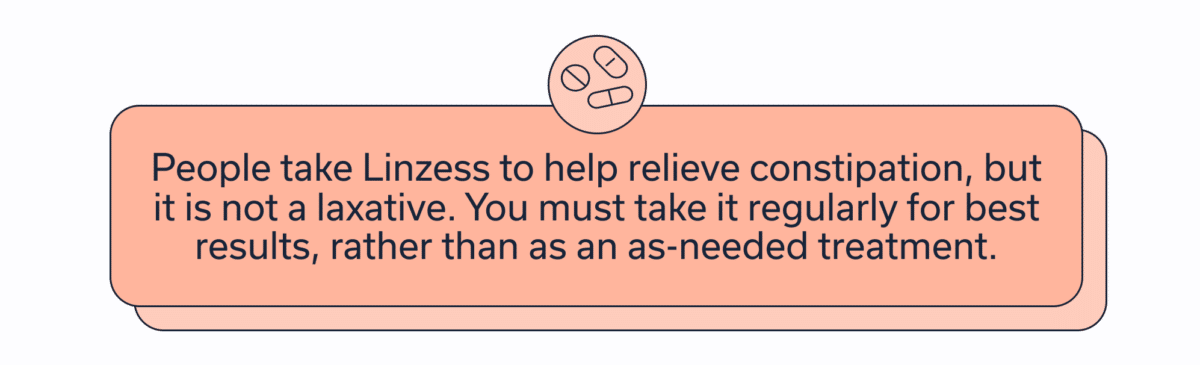
People take Linzess to help relieve constipation , but it is not a laxative. You must take it regularly for best results, rather than as an as-needed treatment.
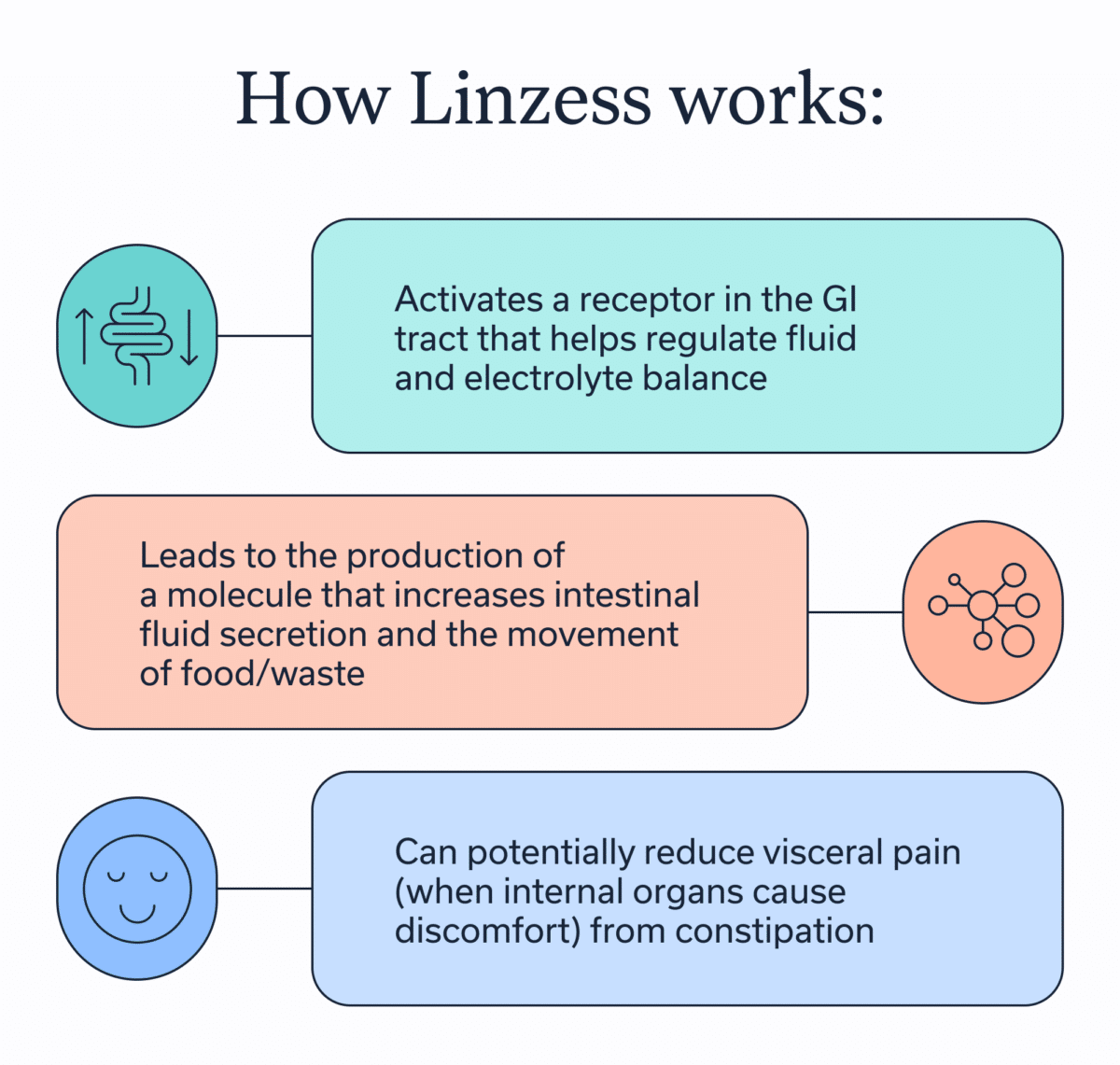
Linzess is a secretagogue that works by increasing intestinal secretions:
-
It activates a guanylate cyclase-C (GC-C), a receptor found in the GI tract that helps regulate fluid and electrolyte balance.
-
Activation of GC-C leads to the production of cyclic guanosine monophosphate (cGMP).
-
Then cGMP, a molecule, increases intestinal fluid secretion and motility, the movement of food and waste.
-
Some research also suggests cGMP can reduce visceral pain (when internal organs cause discomfort) from constipation.
Are you looking for generic Linzess? Linaclotide is the active ingredient in Linzess. But a generic option for this medication is not yet available on the market.
Who may be a candidate for Linzess and who shouldn’t use it?
If you’re wondering whether Linzess is right for you, you’ll need to consult a healthcare provider, as the medication is only available via prescription.
Your clinician will likely recommend the alternatives listed in this article as a first-line treatment option for IBS-C, CIC,But if you still experience chronic constipation that is affecting your quality of life, then Linzess may be an option for you.
Who should not take Linzess?
-
People who have a mechanical GI obstruction (a blockage)
-
Those with an allergy to the ingredients
-
Those who are pregnant or trying to become pregnant
-
Children under age 2
-
People at risk for dehydration or severe diarrhea
How to take linaclotide
If you do receive a prescription for Linzess (linaclotide), you may be wondering how to take it. You should always follow your clinician’s instructions for taking a medication, but here are a few general tips for taking Linzess.
-
Start your medication on a weekend or sometime when you don’t have immediate plans, so you can take some time to ease in and see how the medication might affect you.
-
Take your medication around the same every day, rather than as needed. Keep in mind that Linzess can take a week or longer of continuous use before you find symptom relief.
-
Do not take more than the recommended dose.
-
Do not double up on doses if you miss a dose.
-
Take Linzess on an empty stomach at least 30 minutes before your first meal each day.
-
If you have trouble swallowing, you can open the capsule and sprinkle onto applesauce or into a glass of water.
-
Allow time for bowel movement before going out in public or anywhere that doesn’t have a restroom. This is because Linzess can cause diarrhea as a side effect.
Common side effects
As with any drug, Linzess has some potential side effects.
Common side effects:
-
Diarrhea
-
Abdominal pain, pressure, distension, or cramping
-
Gas
-
Stool urgency
-
Bloating
Less common adverse reactions include fecal incontinence, dyspepsia, and viral gastroenteritis.
The medication is also contraindicated for patients with a history of an intestinal obstruction. If you experience any of these more serious side effects, contact your provider or seek medical attention as soon as possible:
Serious side effects:
-
Severe diarrhea
-
Dehydration
-
Allergic reaction
Working with Oshi Health
Oshi Health provides multidisciplinary care for whole-person comprehensive GI health. Your care team might include a GI provider (a nurse practitioner or physician associate), a GI registered dietitian, and/or a gut-brain specialist, all overseen by board-certified gastroenterologists . They collaborate to help you improve your gut health and manage chronic conditions. You’ll have access to unlimited virtual visits with your care team, with appointments available within days.
For symptoms of IBS-C, CIC, and FC, your care team will recommend alternatives to Linzess first to see how you respond. If you continue to experience chronic constipation, then a prescription for Linzess may be right for you.

Key takeaways
-
Linzess is a prescription medication with the active ingredient linaclotide, which helps treat chronic constipation in people with IBS-C, CIC, or FC.
-
Your clinician may recommend alternatives to Linzess first, including soluble fiber, magnesium oxide, and PEG.
-
If you’re experiencing chronic constipation, Oshi Health can help.
FAQ
-
Linzess is not approved for use in toddlers. For pediatric use, the medication is approved for patients 7 years or older with irritable bowel syndrome with constipation (IBS-C) or FC. The biggest risk regarding use in young children is serious dehydration, and that’s one of the reasons it is not approved for toddlers.
-
Linzess hasn’t been adequately studied in pregnant people. If you are pregnant, trying to get pregnant, or are breastfeeding, talk to your clinician about the safest treatment plan for your constipation symptoms.
-
MiraLAX and Linzess are two different medications, making them difficult to compare. The active ingredient in MiraLax is polyethylene glycol (PEG), which pulls water into the intestines, helping to produce a bowel movement and making stool easier to pass. MiraLAX is an over-the-counter option that you can take any time during the day with or without food. Linzess is a prescription medication containing the active ingredient linaclotide. It works by increasing fluid secretions in the intestines to help produce a bowel movement. The directions recommend taking it daily at least 30 minutes prior to your first meal. Healthcare providers may recommend that you try MiraLax first before prescribing Linzess.
-
Dizziness is not a direct side effect of Linzess. However, severe side effects of this medication include diarrhea and dehydration. Both these side effects can cause dizziness or lightheadedness.
-
Linzess and Trulance have a similar cost. The average list price for Linzess is $600 to $750, while the average list prices for Trulance is $700 to $800. Both drugs can be purchased with a manufacturer’s savings card, which may lower the price of Linzess and Trulance to less than $50 or $25 per month, respectively. All pricing will depend on the specifics of your health insurance plan.
Oshi is your partner in digestive health
Feel like your digestive concerns are running your life? You’re not alone—and we’re here to help you find lasting relief.
Oshi Health GI providers, gut-brain specialists, and registered dietitians work together to address your symptoms and find solutions that actually work for you.
Whether you’re dealing with chronic digestive issues or unpredictable symptom flare-ups, our GI specialists deliver:
✔ Personalized care plans tailored to your lifestyle
✔ Science-backed strategies to calm your gut
✔ Compassionate, whole-person care
✔ And so much more!
Ready to take control of your gut health?