



Have you ever asked the question,“what does acid reflux feel like?” While acid reflux is most commonly described as a burning sensation in the chest, others describe it differently, which is why this condition sometimes goes unnoticed.
When you think of acid reflux, the first thing that comes to mind is the feeling of your chest being on fire, aka heartburn . While this is a common symptom, it’s not the only way this condition may manifest.
“A lot of people expect reflux to always feel like this dramatic burning in the chest, and sometimes it does happen, but not always,” says Alyssa Simpson, RDN, CGN, CLT, a registered dietitian specializing in gastrointestinal nutrition, “I see a lot of people having what are basically reflux flares, and they don’t even realize it because for them it’s more throat clearing, coughing, pressure, or excessive belching–things you might not realize could be reflux-related.”
Ahead, we’ll detail the most common acid reflux symptoms and answer the question what does acid reflux feel like with all the possible sensations, not just heartburn.
What does acid reflux feel like? Common signs and sensations
Acid reflux is when the stomach contents (food and stomach acid) travel up the digestive tract, which may cause discomfort. The stereotypical depiction of acid reflux is a burning sensation in the chest or throat.
Admittedly, heartburn is the most common symptom of acid reflux or gastroesophageal reflux disease (GERD), which is when acid reflux becomes a chronic (ongoing) phenomenon. It’s also one of two symptoms that can help diagnose acid reflux and GERD. The other is regurgitation, which is a lingering aftertaste in the mouth because the stomach contents traveled upstream.
In her practice, however, Simpson says some patients describe acid reflux in a number of different ways. Some report a sour taste in their mouth or an irritated or inflamed feeling in the chest that doesn’t feel as intense as heartburn. Simpson herself also has heartburn, and when her symptoms were more severe, she felt like a burning in her throat, especially at night or when stressed.
“I used to experience it more severely as burning in my throat, mouth ulcers, even some tooth erosion from the acid over time,” says Simpson, “Now, mine actually tends to show up more as coughing fits without the burning, and we recently had a client describing it as more of a burning sensation in her mouth.”
Acid reflux symptoms beyond burning
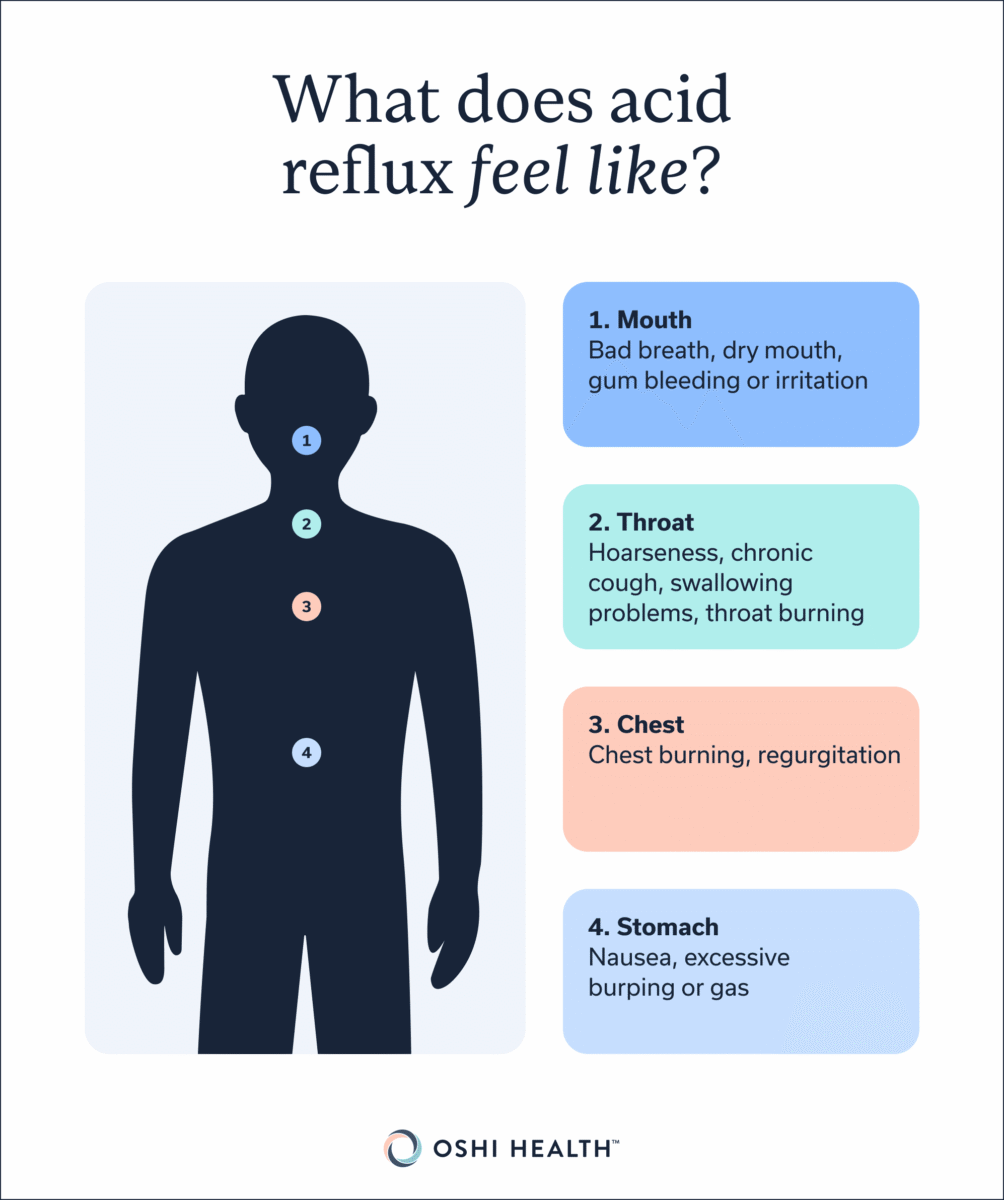
There are a lot of different ways someone may experience acid reflux, including:
- A burning in the chest or throat
- Bad breath
- Chronic cough
- Dental erosion
- Dry mouth
- Excessive burping or gas, especially after eating
- Gum bleeding or irritation
- Hoarseness
- Nausea
- Problems swallowing or pain when swallowing
- Regurgitation
- Throat clearing
“So reflux can definitely present beyond just the stereotypical’heartburn’ feeling,” says Simpson, “especially with silent reflux.” Silent reflux, medically referred to as laryngopharyngeal reflux, is when the stomach contents travel back up the digestive tract, but the person doesn’t experience heartburn. Instead, symptoms are concentrated in the throat or mouth, like hoarseness or a chronic cough.
Acid reflux vs heartburn
To understand acid reflux vs heartburn, we have to take it back to anatomy 101. The digestive tract is the system through which food moves, starting in the mouth. Food then goes through the esophagus, a long tube that carries food from the mouth to the stomach. From there, it travels through a few different body parts that take any nutrients the body needs out of food, carrying the rest to the anus, where it leaves the body.
You can think of your digestive tract like a river with a strong current that pushes everything downstream. With acid reflux, however, the stomach contents (food and acid in the stomach that helps break down food) come back up. And just like swimming against a current, this can create some discomfort.
In everyday life, we describe that discomfort as acid reflux, heartburn, or GERD, often using the three interchangeably. But there are some differences between these terms:
- Acid reflux: This is the underlying condition (i.e., when stomach contents travel up the digestive tract). It may lead to a variety of symptoms, including heartburn.
- GERD: When the stomach contents flow back upstream two or more times a week, someone may be diagnosed with this chronic condition.
- Heartburn: A burning sensation in the chest or throat is the most common symptom of acid reflux and GERD.
While heartburn is usually a symptom of acid reflux and GERD, it’s sometimes associated with other conditions too. For example, in rare cases, it may be due to heart disease, eosinophilic esophagitis (a condition where too many white blood cells build up in the esophagus), or gallstones (hard deposits in the gallbladder or common duct that sometimes cause gastrointestinal symptoms).
What causes acid reflux
So why exactly would the stomach contents want to travel in the wrong direction? To understand what causes acid reflux, we have to meet one more part of the digestive tract: the lower esophageal sphincter (LES). This is a ring of muscle that controls how food flows between the esophagus and stomach.
When working as intended, the LES relaxes when food enters the esophagus in order to let it travel into the stomach. After, it closes up again. If the LES relaxes at other times or is weak, food (and stomach acid) can flow back upstream.
The LES may relax for many reasons, from one-off triggers like stress or a large meal to structural problems. Common causes include:
- Bariatric surgery: This procedure treats obesity.
- Eating and lifestyle habits: What you eat, when you eat, and other lifestyle factors may contribute to acid reflux, which we’ll detail in the next section.
- Having obesity or being overweight: Excess weight can increase intra-abdominal pressure, meaning the stomach pushes upward and the LES may relax inappropriately.
- Hiatal hernia: This structural problem in the esophagus means the LES is positioned in a way where it can’t fully close.
- Pregnancy: About one in four pregnant people experiences acid reflux or GERD.
- Medications: Some medications, such as some asthma medications and nonsteroidal anti-inflammatory drugs, like aspirin or ibuprofen, may be to blame, too.
When symptoms happen and what patterns to notice
If you experience heartburn or other symptoms that might be related to acid reflux or GERD (see the list above), jotting down any possible triggers may help a healthcare provider create an appropriate treatment plan.
We typically think of an acid reflux trigger as a type of food, such as caffeine, a citrus fruit, or something spicy.
When Simpson discusses acid reflux with patients, many are surprised to find out that acid reflux isn’t just because of eating a specific food. “Sometimes it’s more pressure-related, so things like bloating, constipation, overeating, tight clothing, all of that can contribute too,” explains Simpson.
She adds that another really common pattern is acid reflux worsening at night. Bedtime acid reflux is more likely to occur if someone eats a large meal within three hours of lying down (either to sleep for the night or even just for a nap).
Another unexpected trigger is stress or emotional distress. In fact, there’s an association between acid reflux and mental health conditions like chronic stress, anxiety, and depression, though researchers don’t fully understand the connection yet.
To discover the unique patterns of your acid reflux, keep a symptom log with:
- Any symptoms you experience and the severity of each
- The time when acid reflux symptoms occur
- What position you were in when symptoms occurred (i.e., lying down, standing, sitting)
- What you ate recently
- Your emotional state when symptoms occurred
How acid reflux is diagnosed
GI providers, such as gastroenterologists or physician associates with specialized training in gastroenterology, typically diagnose acid reflux or GERD based on recurring symptoms and a patient’s medical history.
Sometimes, a GI provider will order medical tests, such as:
- Upper GI endoscopy: A procedure where a doctor places a long tube called an endoscope into the upper GI tract. This tube has a camera on it, allowing the provider to search for signs of damage.
- Esophageal pH monitoring: A test to detect any stomach acid in the esophagus. It uses either a catheter, a long tube stuck down the nose that measures acid, or a capsule that is placed in the esophagus by an endoscope.
- Esophagram: When someone drinks a special barium solution, then gets an X-ray of the upper digestive tract. This often assesses the structure of the esophagus.
Why diagnosis matters
It can be easy to write off acid reflux or GERD as”just heartburn,” but when GERD is left untreated, it may lead to serious or dangerous complications. Simpson, for example, mentioned experiencing tooth decay, which is much more common in people with GERD than in the general population.
GERD also increases the risk of esophageal cancer and may lead to serious complications, such as asthma-like difficulty breathing or Barrett’s esophagus, a condition where the esophagus lining changes.
With or without any complications, GERD and acid reflux also decrease someone’s quality of life and increase the chance of experiencing stress or anxiety. The symptoms of GERD and acid reflux are reason enough to get an accurate diagnosis and treatment plan.
Treatment options for acid reflux
Once someone has a GERD diagnosis, a GI provider will create a customized treatment plan. For many GI providers, the first line of defense is proton pump inhibitors (PPIs), a class of medications that slows stomach acid production.
Despite their popularity, 20-40% of cases don’t respond to these drugs. Even in the cases where they work, PPIs don’t build the lifestyle habits that address acid reflux triggers.
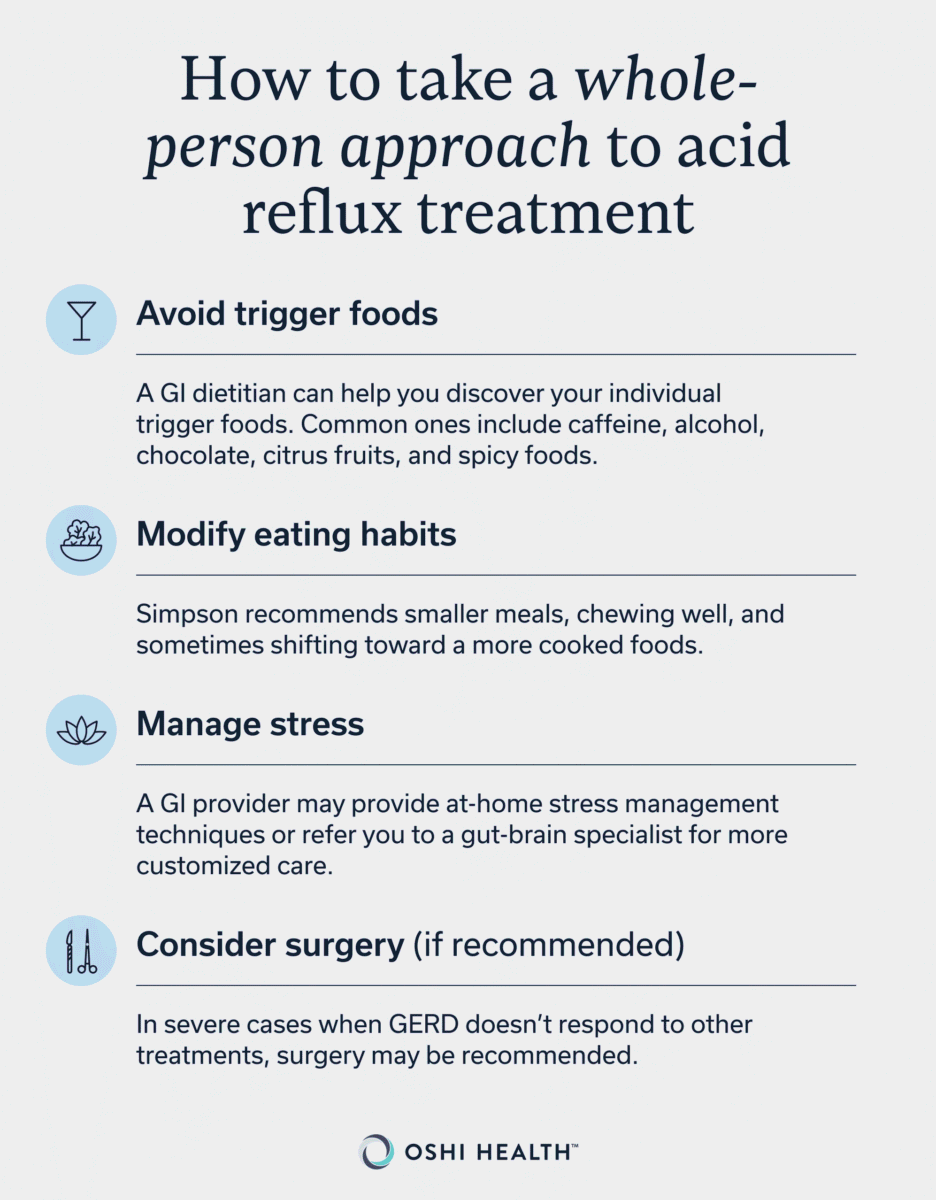
That’s why GI providers like Oshi Health take a whole-person approach. Alongside medication when appropriate, this treatment style may also include:
- Avoiding trigger foods: A GI provider may refer someone to a GI-focused registered dietitian who can help them discover their individual trigger foods. While these differ from person to person, common ones include caffeine, alcohol, chocolate, citrus fruits, and spicy foods.
- Changing eating habits: “A lot of people miss that reflux is not always just about acid, sometimes it’s also about food sitting in the stomach too long and creating pressure,” explains Simpson, “So I often focus a lot on things like smaller meals, chewing really well, supporting regular bowel movements, and sometimes even shifting toward a little more cooked and lighter foods for a period of time to ease digestion and help the stomach empty a little more efficiently.”
- Managing stress: When Simpson first started her own treatment journey, she cut out every classic trigger food, but still got reflux. Turns out, a massive piece for her (and many patients) was stress. “I wish I knew earlier on that reflux is not always only about avoiding the ‘bad’ foods,” Simpson reflected, “Sometimes it’s also the gut-brain connection.” In these cases, a GI provider may provide at-home stress management techniques or refer someone to a gut-brain specialist for more customized care.
- Surgery: In severe cases when GERD doesn’t respond to other treatments, surgery may be recommended.
What foods neutralize stomach acid immediately?
A GI provider may also refer patients with GERD to a GI-focused registered dietitian (RD). A RD can help someone create a GERD diet to relieve symptoms and prevent future flares.
But what foods neutralize stomach acid immediately? The answer is not many, if any at all. It’s better to view acid reflux as something to treat gradually, not within a few minutes of a flare hitting. That said, some evidence suggests some over-the-counter medications, like antacids, may provide quick relief in mild cases, though additional treatments are required to prevent future flares.
Working with a healthcare provider
If regularly experiencing any acid reflux symptoms (even if the classic heartburn sensation is MIA), see a healthcare provider. This could be a primary care provider who may refer you to a specialist, or you could go directly to a GI provider, such as the team at Oshi Health.
To help the GI provider figure out what’s going on, bring a log of your symptoms, as well as any foods you suspect may be triggering them. A list of medications or supplements (including any dosages) may also be useful as well.
When to seek care right away
Acid reflux and GERD usually aren’t a medical emergency. That said, here are some signs to seek care right away:
- Extreme difficulty or pain swallowing
- Food feels stuck and makes it difficult to breathe
- Severe or unexplained chest pain
- Shortness of breath, especially if accompanied by dizziness or a numb or tingling sensation
- Unexplained and sudden weight loss
- Vomiting blood or passing bloody stools








Key takeaways
-
Acid reflux most commonly feels like a burning sensation in the chest or throat. However, heartburn isn’t present in all cases of acid reflux. Sometimes, it may feel like hoarseness, difficulty swallowing, or dry mouth.
-
Acid reflux symptoms also include bleeding gums, chronic cough, bad breath, excessive burping or gas, nausea, or problems swallowing.
-
If you experience any symptoms that may be from acid reflux or GERD, see a GI provider, such as the team at Oshi Health, especially if symptoms occur two or more times a week.
Frequently asked questions (FAQs)
-
The terms acid reflux and heartburn are often used interchangeably, but they are different. Heartburn refers to the fiery ache in the chest, which is the most common symptom of acid reflux. Acid reflux is when the stomach contents flow back up the digestive system. Along with heartburn, acid reflux may cause other symptoms, such as a chronic cough or difficulty swallowing.
-
Acid reflux commonly feels like chest pain. Often, patients describe it as a burning sensation, as indicated by the term”heartburn.”
-
Acid reflux has many potential triggers. Everyone’s triggers are individual, but common ones include acidic foods like citrus fruits or juices, chocolate, caffeine, stress, and eating a large meal before bed.
-
It is rare that anyone dies of acid reflux when sleeping. However, if left untreated GERD, which is the term for chronic acid reflux, may increase the risk of complications that may lead to death, such as difficulty breathing at night or esophageal cancer.
Deep dive recommendations
If you’d like to learn more about acid reflux and GERD, here’s some recommended reading:
- National Institute of Diabetes and Digestive and Kidney Diseases. Acid reflux and GERD in adults.
- Johns Hopkins Medicine. Gastroesophageal reflux disease (GERD).
- Oshi Health. GERD diet plan.
- Harvard Health. Could stress be making your acid reflux worse?
Oshi is your partner in digestive health
Feel like your digestive concerns are running your life? You’re not alone—and we’re here to help you find lasting relief.
Oshi Health GI providers, gut-brain specialists, and registered dietitians work together to address your symptoms and find solutions that actually work for you.
Whether you’re dealing with chronic digestive issues or unpredictable symptom flare-ups, our GI specialists deliver:
✔ Personalized care plans tailored to your lifestyle
✔ Science-backed strategies to calm your gut
✔ Compassionate, whole-person care
✔ And so much more!
Ready to take control of your gut health?