


Key takeaway: Where do you draw the line between run-of-the-mill constipation and an actual fecal impaction? Whilst both indicate something’s up with your gastrointestinal (GI) tract, fecal impaction is more concerning. Constipation is when you have difficulty pooping or when you poop infrequently. Fecal impaction, on the other hand, is when poop becomes a hardened lump, blocking your bowels. A key difference is that fecal impaction can’t be treated at home and requires prompt medical intervention. It’s important to address constipation before it progresses to a potential fecal impaction.
Constipation is one of the most common GI complaints in the United States, contributing to over 2.5 million doctor visits every year. So, most of us have been there: it’s been a few days (or maybe longer) since you last pooped, and you’re feeling pretty uncomfortable. At this point, you might be wondering if you’re experiencing not just constipation, but a full-on fecal impaction.
Constipation and fecal impaction exist on the same spectrum, but fecal impaction is more serious. The sluggish movement of stool through your intestines can become so backed up that it creates a hardened blockage, or fecal impaction.
It might be helpful to think of this like the drains in your home. If you’ve got enough hair stuck in a shower drain or food and grime stuck in your kitchen sink drain, then this can cause a pipe blockage. At first, the water in your tub or sink drains slowly. But at some point, it can become completely blocked and stop draining altogether. This is when you bring in the big guns, AKA drain cleaner, to blast through that gunk and get things moving through your pipes again. Your GI system is a little more complicated than household plumbing, but the metaphor is still helpful.
Overall, fecal impaction is more severe than constipation, and it also requires medical attention to clear. Trying to treat it at home could lead to injuries and complications. Let’s take a deeper look at the differences between constipation and fecal impaction, as well as their diagnosis, treatment, and prevention.
Fecal impaction vs constipation: what each one means
“Fecal impaction can be thought of as very severe constipation,” explains Yuying Luo, MD, a gastroenterologist and assistant professor of medicine at Mount Sinai. You might have also heard it called an “impacted bowel,” which is a lay term that some people use for fecal impaction.
Think of it like this: constipation is a symptom pattern, where you have less than three bowel movements per week, hard stools, or trouble passing stool or incomplete evacuation. Fecal impaction is a complication of constipation. It happens when stool builds up (usually in your rectum) and hardens, becoming difficult or impossible to pass naturally.
Whilst constipation can improve with hydration, fiber, movement, or short-term medications (like stool softeners, osmotic agents, or stimulants), fecal impaction is quite a bit more difficult to resolve. “Fecal impaction will not clear on its own without medical therapies,” says Dr. Luo.
Symptoms of constipation vs fecal impaction
Fecal impaction symptoms are more severe than constipation symptoms. If you’ve been constipated on and off for a while and then feel your constipation worsening, this could be a sign of fecal impaction.
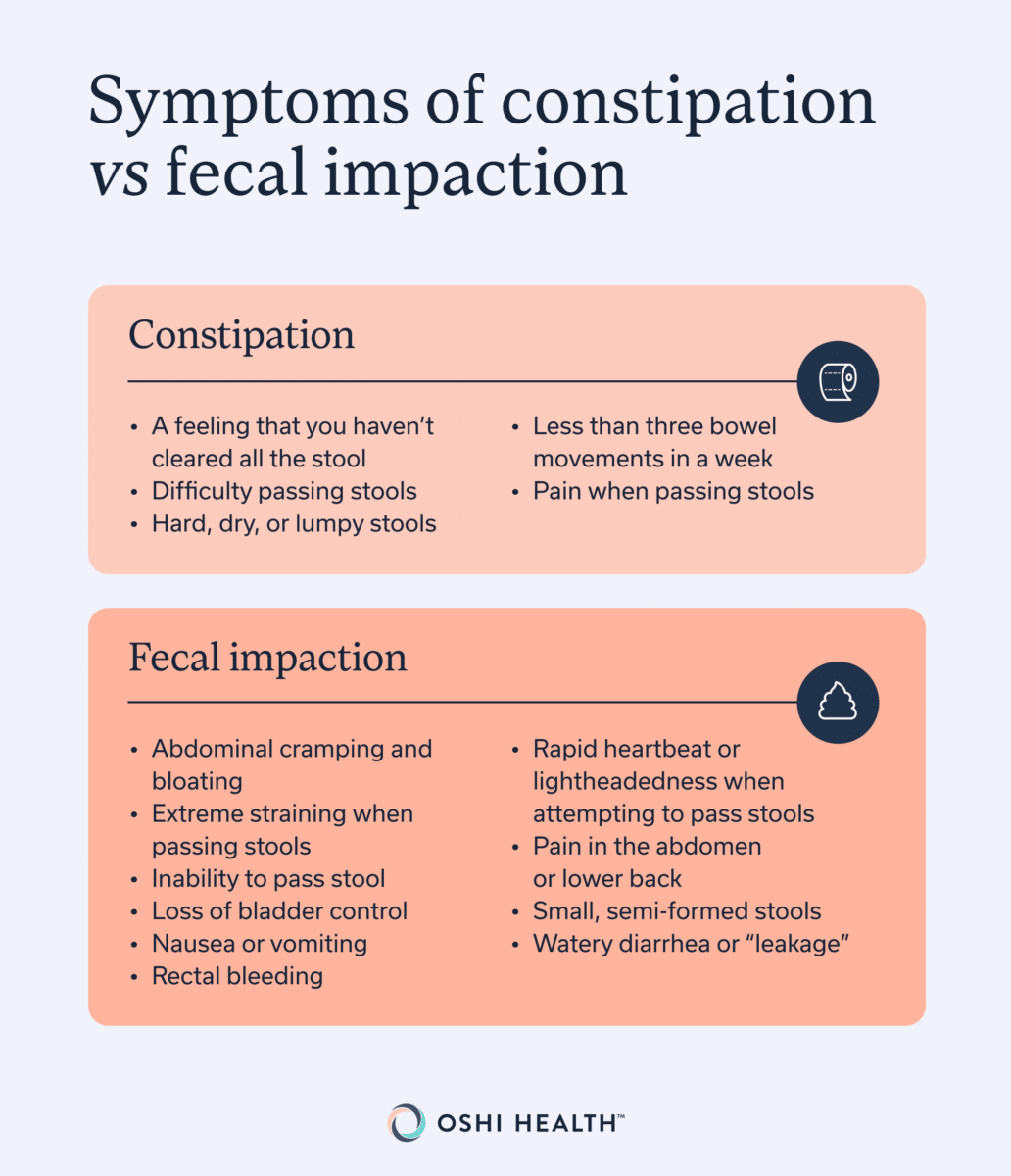
Constipation symptoms include:
- A feeling that you haven’t cleared all the stool
- Difficulty passing stools
- Hard, dry, or lumpy stools
- Less than three bowel movements in a week
- Pain when passing stools
Fecal impaction symptoms include:
- Abdominal cramping and bloating
- Extreme straining when passing stools
- Inability to pass stool
- Loss of bladder control
- Nausea or vomiting
- Pain in the abdomen or lower back
- Rapid heartbeat or lightheadedness when attempting to pass stools
- Rectal bleeding
- Small, semi-formed stools
- Watery diarrhea or “leakage”
It may seem contradictory to experience diarrhea if you have severe constipation, but that symptom can be a key clue to what you’re dealing with. “Patients [with fecal impaction] may feel inability to pass stool or gas, or they can actually have paradoxical ‘overflow’ diarrhea,” explains Dr. Luo. “[This is] where liquid bowel movements leak around a solid mass of stool.”
What causes fecal impaction and severe constipation
Fecal impaction is essentially a severe, advanced type of constipation, and constipation has many possible causes.
The most common causes of constipation include:
- Dehydration
- Delaying bowel movements
- Medication side effects
- Not eating enough fiber
- Not getting enough physical activity
- Pregnancy
- Sudden changes in diet, such as during travel
There are some less commonly considered causes of constipation, as well:
- Central nervous system conditions, such as Parkinson’s disease, multiple sclerosis, or stroke
- Eating disorders
- Endometriosis
- GI conditions, such as celiac disease, IBS-C, IBD, SIBO, gastroparesis, and more
- Hormonal conditions, such as hypothyroidism
- Intestinal obstruction, such as from a tumor
- Laxative abuse
- Metabolic conditions, such as diabetes
- Pelvic floor dysfunction
- Spinal cord or brain injury
So, when it comes to causes of fecal impaction, the primary culprit is constipation that’s gone untreated for too long. Chronic constipation is usually defined as having fewer than three bowel movements a week for three months or longer.
Certain lifestyle or physical circumstances can also raise your risk of fecal impaction—namely, limited physical activity. “Fecal impaction can be seen more often in patients who are bedbound or have limited mobility, or in patients who are hospitalized with critical illness,” says Dr. Luo.
Taking barium (a solution that’s sometimes used in medical settings during imaging) either by mouth or via an enema can also raise the risk of developing fecal impaction.
How doctors diagnose fecal impaction vs constipation
Constipation is diagnosed based on symptoms and medical history, whereas fecal impaction diagnosis can require a rectal exam or imaging.
To diagnose constipation, your clinician will ask you questions about:
- Any symptoms you have
- How often you pass stool
- Medical history
- What the consistency of the stool is (hard, soft, lumpy, etc.)
- Your medications
They may also examine you physically, for example, by pressing on your abdomen. If they suspect a fecal impaction, this physical assessment will usually include a rectal exam. This is when your clinician inserts a gloved finger into your rectum to feel for any hard lumps of stool that might be lodged there.
If that sounds embarrassing, try not to worry. “I always tell my patients that gastroenterologists have seen and heard it all, and we are here to help,” assures Dr. Luo. You can also request a support person to be present.
Sometimes, when a fecal impaction is suspected, you may also undergo imaging like a computed tomography (CT) scan of your abdomen. This is especially common in urgent care or emergency settings. This will provide your clinicians with detailed pictures of your insides, which can show if there is an impaction either in your rectum or higher up in your colon.
Less frequently, you might get a plain X-ray of your abdomen (which doesn’t give quite as much detail as a CT scan), or a contrast enema (another type of X-ray which uses barium to highlight your intestines in the image, but barium can also trigger fecal impactions).
If your clinician suspects other health conditions might be at play, they might ask you to undergo additional procedures, like blood tests or a colonoscopy, to help rule them out.
Fecal impaction treatment: how to clear an impacted bowel safely
Treating a fecal impaction starts with removing the blockage. Unlike constipation, fecal impaction is very unlikely to clear on its own, and medical intervention is needed.
“Stool can become impacted anywhere in the colon, but most commonly in the rectum,” says Dr. Luo. Common treatments for fecal impaction include:
- Enemas: A procedure that inserts liquid into your rectum to help loosen your poop. Your clinician may need to use a thin, flexible tube to deliver the enema past the impaction. They may also massage your abdomen to help loosen the stool. Don’t try this at home with an over-the-counter enema, unless your clinician has instructed you to.
- Laxatives: These are medications that help you poop, and they can be given as a suppository (a bullet-shaped medication that’s inserted into the rectum) or taken orally (as either a drink or a pill). Polyethylene glycol is the typical laxative for impaction in the rectum. Magnesium citrate can also help.
“If the fecal impaction in the rectum is severe, manual disimpaction may be needed by a medical professional,” says Dr. Luo. This involves a skilled clinician physically removing the stool from your rectum, usually with a gloved index finger and lots of lubricant. In some cases, they may use tools like an anoscope (an anal speculum with a light on it) and suction. An anesthetic ointment is usually used for pain relief. Again, don’t attempt this at home, because you could injure yourself.
In rare cases, surgery for fecal impaction may be required. This is typically only done if you have complications, such as peritonitis (an infection of the inner lining of your abdomen), or an intestinal perforation (a tear in your intestines).
Remember, there are no diets or home remedies that can solve an impaction once it’s formed. Continually trying to treat yourself at home could delay needed medical care if your symptoms suggest an impaction.

How do you know when fecal impaction has cleared
Most people can tell when their fecal impaction has cleared because they’ll finally be able to pass stool—and experience a feeling of relief that their bowel has successfully emptied.
Some other signs include:
- Less bloating
- Less pressure
- Reduced abdominal, back, or rectal pain
Your symptoms should continue to improve after your initial medical treatment. Having regular, normal bowel movements is a sign that your impaction is gone. If you go right back to being constipated after you’ve been “cleaned” out, this is a sign that there’s still a blockage and you require additional treatment.
If you continue to have constipation, pain, bloating, leakage, nausea, or trouble passing stool, then make a follow-up appointment ASAP.
How constipation is treated and how to heal afterward
Constipation, unlike fecal impaction, can often be treated at home or in an outpatient setting. It’s useful to get advice from a GI clinician, especially if your constipation is a long-standing issue. Not only could this help you feel better, but it could also prevent dangerous complications of constipation in the future.
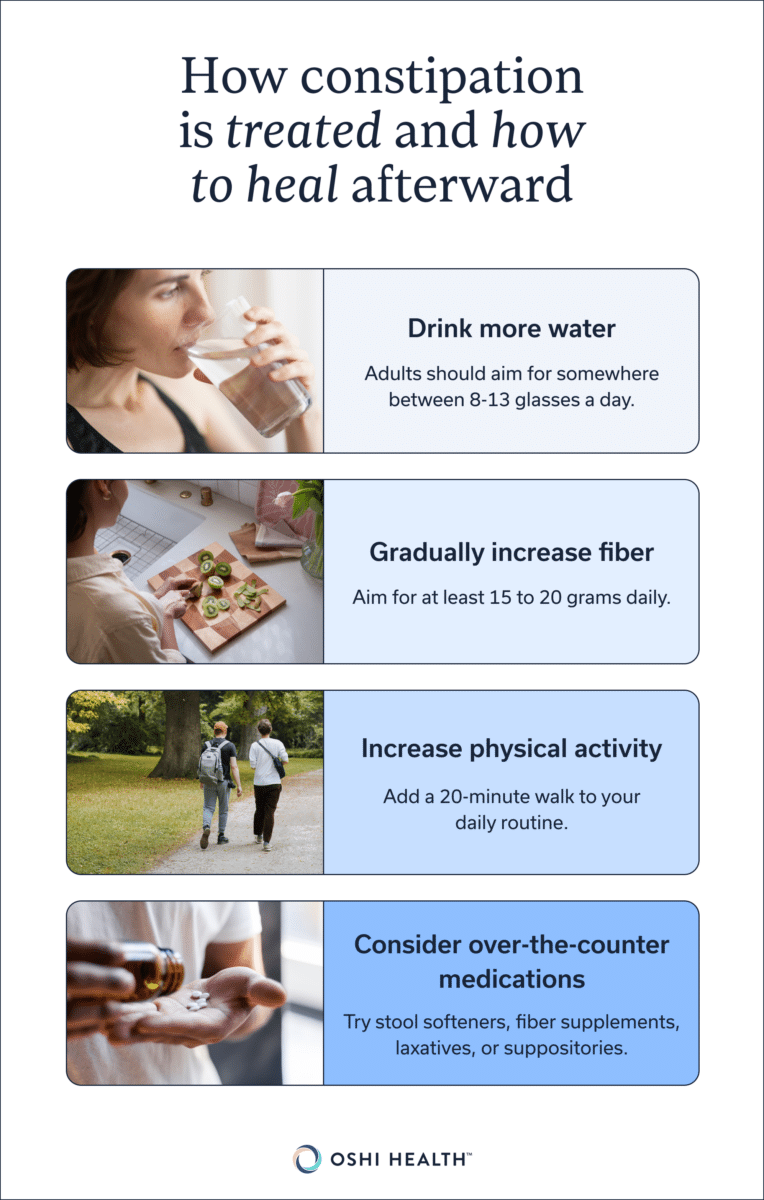
First-line treatment for constipation often includes:
- Drinking more water
- Gradually increasing fiber (up to at least 15 to 20 grams daily)
- Increasing physical activity
- Over-the-counter medications such as stool softeners, fiber supplements, osmotic laxatives, stimulant laxatives, or suppositories
“In general, fiber is helpful for constipation, such as prunes and dried apricots,” says Dr. Luo. There is also evidence that eating two kiwis a day can be helpful for constipation, due to the unique kind of fiber they contain.
Remember: try to add fiber to your diet slowly. Adding too much too soon can result in unpleasant symptoms like gas, bloating, and worsened constipation, which is obviously not what you’re aiming for.
For some people, prescription medications to treat constipation can also help, especially if the constipation is chronic and doesn’t respond to lifestyle changes.
If you feel overwhelmed with these treatment options, you’ve been dealing with on-and-off constipation for a while, or you’ve already tried the most generic recommendations, then it’s certainly worth chatting to a professional about your constipation. Consider making an appointment with a multidisciplinary GI care team, like the one at Oshi Health, where you can get personalized advice from GI clinicians, registered dietitians, and gut-brain specialists.
Healing from constipation involves not just treating the symptoms (AKA getting you a successful poop), but also addressing the underlying cause of your constipation. That cause might be unwanted medication side effects, pelvic floor issues, a low-fiber diet, an undiagnosed health condition, or something else.
Working with a healthcare provider
Working with a healthcare provider can help, whether you have fecal impaction or constipation. There are a few key things to keep in mind when deciding whether you should schedule an appointment or head straight to urgent care.
When to schedule an appointment
“If you’ve gone a few days without a bowel movement, you should try to see a gastroenterologist or your primary care doctor for further evaluation as soon as possible,” recommends Dr. Luo. “They can help guide further treatment, and if you need emergency care.”
Some things that might help you before your appointment include:
- Consider tracking your bowel movement frequency and consistency
- Keep a record of episodes of constipation
- Note any symptoms like abdominal pain, rectal bleeding, or leakage
- Share a list of your current medications
Whether you have fecal impaction or chronic constipation, you deserve a tailored health plan, and not just rescue treatments on repeat. Oshi Health can help you get to the bottom of what’s causing your issues and make long-term changes that will keep you regular.
When to seek care right away
If your symptoms suddenly worsen after a period of constipation, then you might require more urgent care. “Seek emergency care if [you’re] unable to pass gas, [have] intense abdominal pain, or are having nausea or vomiting,” Dr. Luo adds. “These are signs of a fecal impaction or another serious condition.”
Some red flags that should have you heading to the emergency room include:
- Confusion
- Distended abdomen
- Fever
- Inability to pass stool or gas
- Rectal bleeding
- Severe abdominal pain
- Vomiting
- Weight loss
While it might just seem like a bad case of constipation, fecal impaction should be taken seriously because it can become dangerous if left untreated.
The Takeaway
- Fecal impaction is a severe type of constipation in which the stool creates a blockage in the bowel.
- Worsening pain, bloating, overflow diarrhea, straining, lightheadedness, and being completely unable to pass stool are signs that you might have a fecal impaction.
- Constipation can be treated with diet and lifestyle changes. Fecal impaction, on the other hand, will not clear without medical therapies.
- The safest path to healing from a fecal impaction starts with recognizing the difference between constipation vs fecal impaction early, and getting the right treatment.
- Even if you “only” have constipation, consider seeking help from a GI care team like Oshi Health. They can help uncover and treat the underlying cause of your constipation, and also prevent your constipation from progressing to a fecal impaction.
Frequently Asked Questions (FAQs)
How do you know if you are constipated or impacted?
If you’ve been constipated for a while and feel your symptoms worsening, then you may have a fecal impaction. Fecal impaction can also come with symptoms like diarrhea, nausea, extreme straining, and a rapid heartbeat or lightheadedness while you’re trying to poop.
Can I have fecal impaction and still poop?
It’s possible to have a fecal impaction and still poop. You may experience watery leakage or diarrhea that “overflows” around your blockage. Some people with fecal impaction are also able to pass very small, hard balls of stool.
Is fecal impaction an emergency?
Fecal impaction requires medical attention, since it cannot be cleared on its own. However, some cases are more urgent than others. If you have symptoms like lightheadedness, vomiting, fever, or severe abdominal pain, then this could signal a complication such as infection or intestinal perforation that requires emergency care.
What are the first signs of impaction?
The first signs of impaction are not being able to poop after a period of constipation, inactivity, diet change, or taking barium. You may also have bloating, cramping, and straining when trying to go.
How to get rid of fecal impaction?
Getting rid of a fecal impaction requires assistance from medical professionals—it won’t go away on its own. You may have to do an enema, or take laxatives via a suppository, drink, or pill. Some cases also require manual disimpaction.
Oshi is your partner in digestive health
Feel like your digestive concerns are running your life? You’re not alone—and we’re here to help you find lasting relief.
Oshi Health GI providers, gut-brain specialists, and registered dietitians work together to address your symptoms and find solutions that actually work for you.
Whether you’re dealing with chronic digestive issues or unpredictable symptom flare-ups, our GI specialists deliver:
✔ Personalized care plans tailored to your lifestyle
✔ Science-backed strategies to calm your gut
✔ Compassionate, whole-person care
✔ And so much more!
Ready to take control of your gut health?