Unmanaged GI side effects are quietly eating into the return on your GLP-1 coverage. Here’s what you can do about it.
Your organization made a bet on GLP-1s. The clinical case is strong, employees are asking for it, and coverage has become increasingly common across many industries. But there’s a cost hiding inside that investment that doesn’t show up on a pharmacy claims report: gastrointestinal side effects that go unmanaged—putting the population outcomes and the investment at risk.
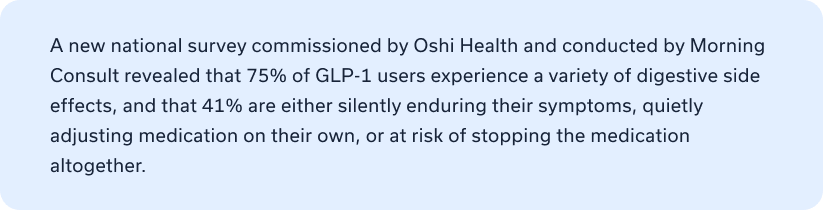
New survey data from Oshi Health, fielded by Morning Consult, puts a number on what’s mostly been anecdotal until now. And the number is bigger than most benefits teams expect.
The medication compromise
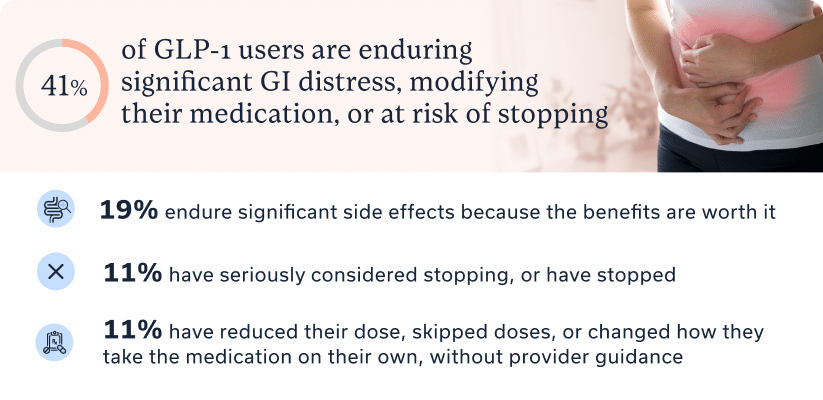
Oshi Health / Morning Consult survey, June 2026 (n=1,012 current and recent GLP-1 users)
Nearly one in five of your GLP-1 population is white-knuckling through side effects because they’ve decided the trade-off is worth it. That’s not nothing—it’s accepting a daily toll on their quality of life and forgoing the specialized care that is proven to help.
The adherence risk
One subset of your GLP-1 population has already or is considering giving up a potentially life-altering medication.
And many others are modifying their medication on their own, without their care team, and often without telling anyone.
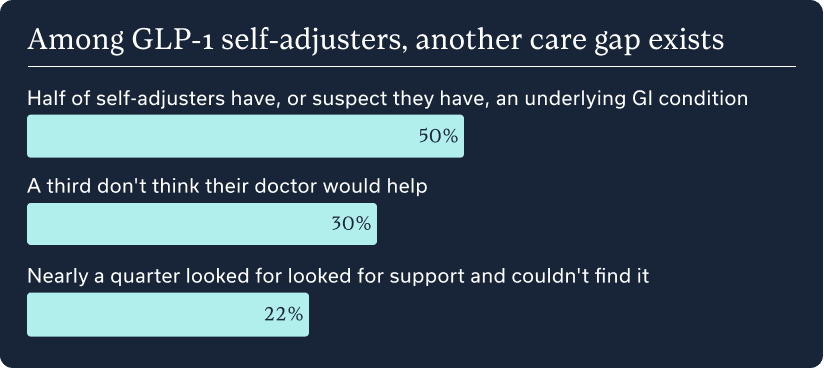
Oshi Health / Morning Consult survey, June 2026
The adherence problem at scale
This isn’t a niche population. If your organization covers GLP-1s, GI side effects are already happening inside your plan at scale—whether or not anyone’s measuring them yet.
1 in 8 U.S. adults now take a GLP-1
Source: KFF; Oshi Health / Morning Consult survey, June 2026
- Up 6 points in 18 months (KFF)
- 75% of users report at least one digestive side effect
The care gap
The problem isn’t just what symptoms occur—it’s how often they go unaddressed.
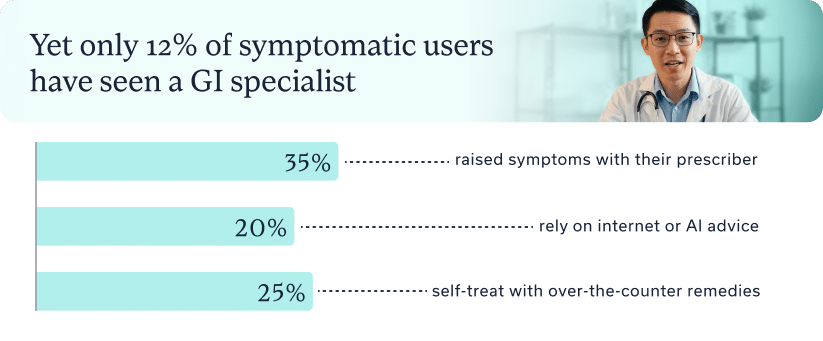
Oshi Health / Morning Consult survey, June 2026
When only a third of symptomatic users are even raising the issue with their prescriber, most of this distress never makes it into a chart, a claim, or a coverage decision. It just shows up later, as claims from outcomes deferred across a range of diabetic or cardiometabolic health conditions.
Where Oshi fits
This is exactly the gap Oshi Health’s multidisciplinary GI care is built to close: GI providers, registered dietitians, and behavioral health specialists working together, so employees get support before side effects turn into a stopped script or an avoidable ER visit.
Oshi’s own outcomes data backs this up: 96% of GLP-1 patients in Oshi’s care achieve symptom control. For a benefits team weighing GLP-1 coverage against its actual return, that’s the variable worth managing.

Nationally, KFF has found side effects running neck-and-neck with cost as a top reason people quit GLP-1s. If your program is only tracking cost-driven discontinuation, you’re missing roughly half the picture.
Talk to Oshi Health about integrated GLP-1 support for your population.
Download the full survey infographic.