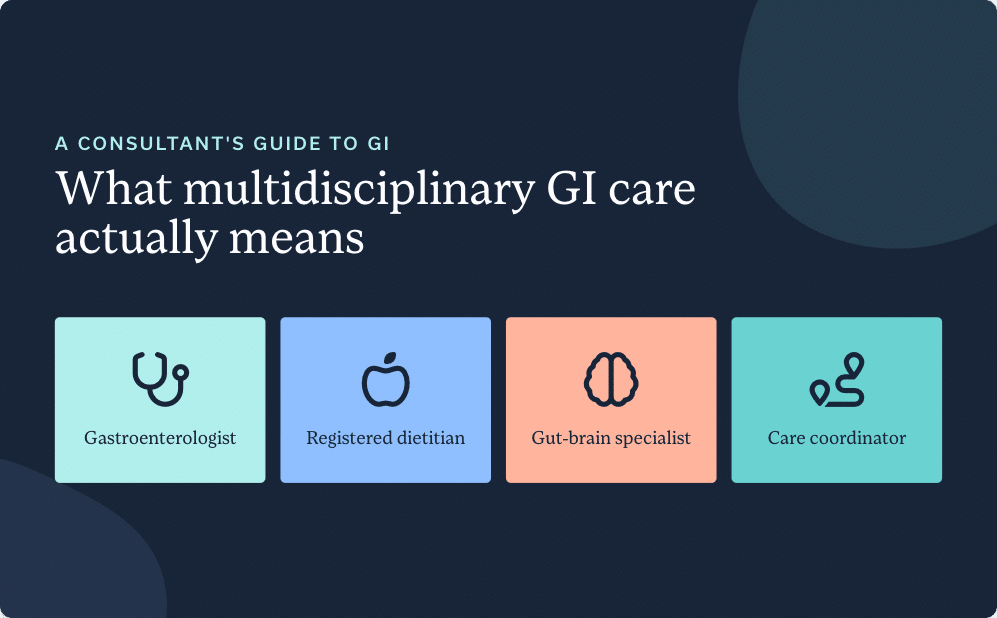
Multidisciplinary GI care – a physician, a GI-specialized dietitian, and a behavioral health clinician working from one coordinated care plan – has a long track record at academic medical centers and research hospitals, where the outcomes data behind thisnintegrated approach has been published and replicated for years. The problem is who can get to it.
There is a version of GI care that works. It has been documented in clinical literature, validated across patient populations, and refined over decades at the nation’s leading academic medical centers. Multidisciplinary GI care – a physician, a GI-specialized dietitian, and a behavioral health clinician working from one coordinated care plan – consistently outperforms the fragmented, single-specialist model most patients actually experience.
The problem: Most of employees live nowhere near these centers of excellence.
That gap between the care that works and the care that is accessible is the single most important thing to understand about why GI conditions keep generating disproportionate, year-over-year cost growth in employer health plans. It is not that the clinical solutions do not exist. It is that they exist in places and at price points that are structurally out of reach for most of the workforce.
What GI center of excellence care looks like
A GI center of excellence is built around a specific clinical design that clinical guidelines have validated for the management of IBS, IBD, and other complex digestive disorders. It starts with an employed GI specialist, a clinician who can evaluate symptoms, reach a diagnosis, prescribe medications, order labs and imaging, and coordinate procedures when clinically indicated. Around that specialist, a GI-specialized registered dietitian addresses the dietary dimensions of the condition, because most GI disorders are significantly influenced by what patients eat and how they eat it, and general nutrition advice is not sufficient for the complexity of conditions like Crohn’s disease or severe IBS. A behavioral health clinician trained in gut-directed therapies, including cognitive behavioral therapy for IBS and gut-directed hypnotherapy, addresses the brain-gut connection that underlies most functional GI disorders. A care coordinator manages the full patient journey, ensuring tests get ordered, results get reviewed, in-person appointments get booked, and patients do not fall through the gaps between appointments that typically characterize fragmented GI care.
When these four roles work together with the time and touchpoints required to help patients actually implement changes to their diet, their stress response, and their medication regimen, patients get sustained symptom control. And when patients achieve sustained symptom control, avoidable utilization stops. Emergency visits drop. Repeat imaging cycles end. The cost trajectory reverses.
Gastroenterologist shortage compounds the access problem
There are only 16,855 gastroenterologists in the United States. Two in three counties have none, regardless of quality. Even in metropolitan areas where specialists are available, the average wait time for a new patient appointment exceeds 30 days. And critically, nearly all genuine multidisciplinary GI programs, the ones that integrate the full care team described above, are located within academic medical centers. They are not accessible via telehealth. They are not available in rural counties. They are not taking appointments within the week. For most employer populations, the care model that works is simply not available.
Virtual care brings the model to the population
Virtual GI care programs built on the clinician-led, multidisciplinary model have made it possible to deliver center of excellence level GI care without the geographic and logistical constraints of an academic medical center. Employees in rural counties, employees who cannot take time off for a weekday specialist appointment, employees who live in two in three counties that have no local gastroenterologist at all, can now access the same clinical model that has been producing strong outcomes in academic settings for decades. Programs operating at national scale provide first appointments within days rather than weeks, with care teams that include the full complement of GI medicine, dietary interventions, and behavioral health.
The outcomes that follow from that access are documented in peer-reviewed claims analyses: 68% reductions in avoidable GI-related emergency visits, 52% reductions in hospital admissions, and per-member cost savings of $6,000 to $11,000 annually.
The clinical evidence for multidisciplinary GI care isn’t new. What’s changed is that it can finally reach the people who’ve never had access to it.