Colorectal cancer is the second leading cause of cancer death in the United States. It is also one of the most preventable, when caught early through guideline-recommended screening. Virtual GI care programs that build CRC screening into every eligible patient interaction demonstrate dramatically higher screening compliance than the national average.
When employers evaluate GI benefit outcomes, the conversation almost always centers on cost savings, avoidable utilization reduction, and symptom control rates. These are the right metrics to track. But there is a fourth outcome category that rarely comes up in benefits conversations and that may be the most consequential one of all: colorectal cancer (CRC) screening compliance.
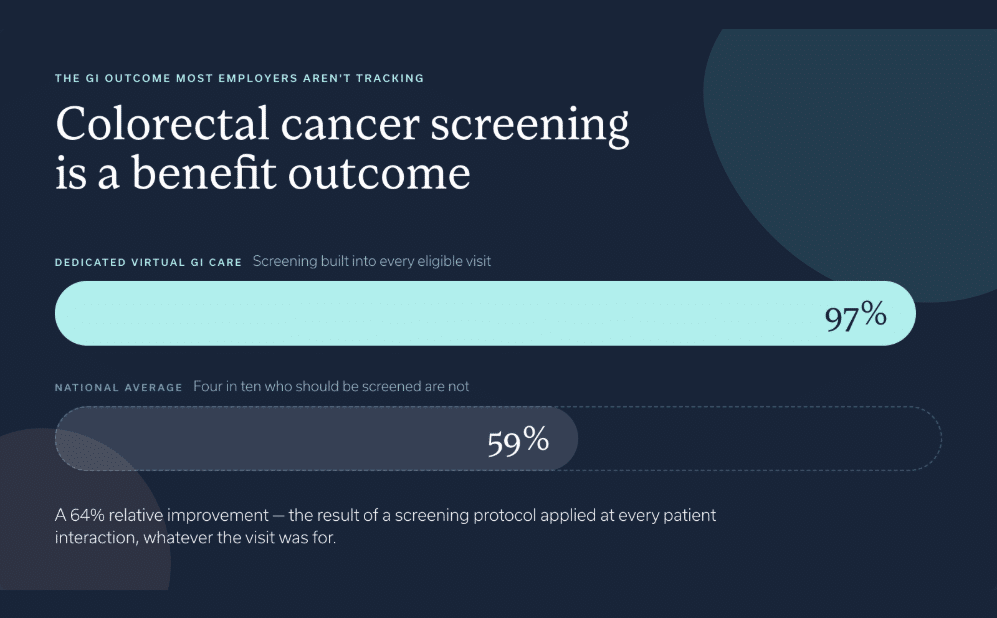
Colorectal cancer is the second leading cause of cancer death in the United States. It is also one of the most preventable, when caught early through guideline-recommended screening. The national average screening compliance rate is 59%. That means four in ten Americans who should be screened for colorectal cancer are not. For employers, this translates directly into late-stage diagnoses, catastrophic claims, and the human cost of a preventable death.
Why people fall through the CRC screening cracks
The barriers to colorectal cancer screening are well documented: lack of awareness, discomfort with the procedure prep, difficulty navigating the referral process, and the same access and wait time constraints that affect all specialty GI care.
Primary care physicians flag the need for screening, but the follow-through rate between a recommendation and a completed colonoscopy or stool test is poor. Without a care team actively managing the patient through the screening process, many patients who intend to get screened just put it off indefinitely.
What a dedicated GI care model can do
Virtual GI care programs that build CRC screening into every eligible patient interaction, regardless of the reason for the visit, have demonstrated dramatically higher screening compliance than the national average. The protocol that drives this result typically follows four steps:
- Education and awareness at the first visit, where patients learn what guideline-recommended screening actually involves; a clinical assessment in which the care team reviews screening options and builds a shared decision-making plan with the patient
- Active support through the screening and diagnostic process itself; and
- Ongoing follow-up in which a GI provider reviews results, discusses any abnormal findings, and determines next steps.
Applied consistently, this protocol has produced a 97% CRC screening compliance rate, compared to a national average of 59%, a 64% relative improvement. This is the result of a systematic clinical protocol applied at every patient interaction regardless of the primary reason for the visit.

For employers, this outcome has financial implications that extend well beyond the GI benefit. A late-stage colorectal cancer diagnosis generates treatment costs that typically run into the hundreds of thousands of dollars. An early-stage diagnosis caught through routine screening is a fraction of that cost. Benefits leaders who are tracking CRC screening rates alongside cost savings and symptom control data are measuring their GI benefit the right way. Those who are not are missing one of its most important impact areas.