



Nausea can really tank how you feel. When the dizziness, funny feeling in your stomach, and sweats strike, you can’t think about anything else. Many issues can cause nausea, including how you’re feeling emotionally. But the good news is you can take steps to calm queasiness quickly.
I’m no stranger to the unpleasant symptom of nausea. I have chronic migraine, and an attack often upsets my stomach and makes me lose my lunch or dinner. I am also prone to motion sickness, so nausea and I are unfortunately well acquainted in ways I wish we weren’t.
For my two examples, the causes are obvious: I’m either in pain or on a plane. But nausea can show up for a host of other reasons, so if you’re suddenly feeling queasy and you don’t know why, you’ve come to the right place to help figure out some potential culprits and what you can do.
In this article, we explore why you might feel nauseous, nausea after eating, what helps with nausea, and more.
Nausea basics: What it is and what your body is signaling
We tend to think of nausea as mainly causing stomach discomfort, but it can involve several other symptoms, including dizziness, feeling a”lump in your throat,” increased sweating, more saliva production, and a loss of appetite.
Nausea has two main functions: serving as a warning sign that something is”off” and helping to prepare your body for vomiting if the need arises.
A warning sign
Nausea is a defense mechanism that warns you about an issue somewhere in your body. Possibilities include:
-
Gastrointestinal (GI) concerns: A toxin (such as alcohol or harmful bacteria) or an irritation (such as too much acid) can affect your stomach or intestines. Your GI tract sends an alert to your brain, and you feel nauseous, preventing you from consuming anything else that could worsen the problem.
-
Vestibular issues: Your inner ear is your balance center. When it experiences a disturbance from repeated movement (such as vehicle travel or spinning on a carnival ride), it alerts you by causing queasiness.
-
Chemoreceptors: The chemoreceptor trigger zone (CTZ) in your brain involves specialized receptors that detect issues in your bloodstream (such as high carbon dioxide levels, low oxygen levels, toxins, etc.) As a result, the CTZ can trigger nausea.
-
Autonomic nervous system: Your gut and brain communicate, and your stress response can disrupt this communication, leading to an upset stomach. This is why you might feel nauseous based on your emotional state, such as when you’re stressed, anxious, or depressed. (More on this below.)
Helps prepare the body for vomiting
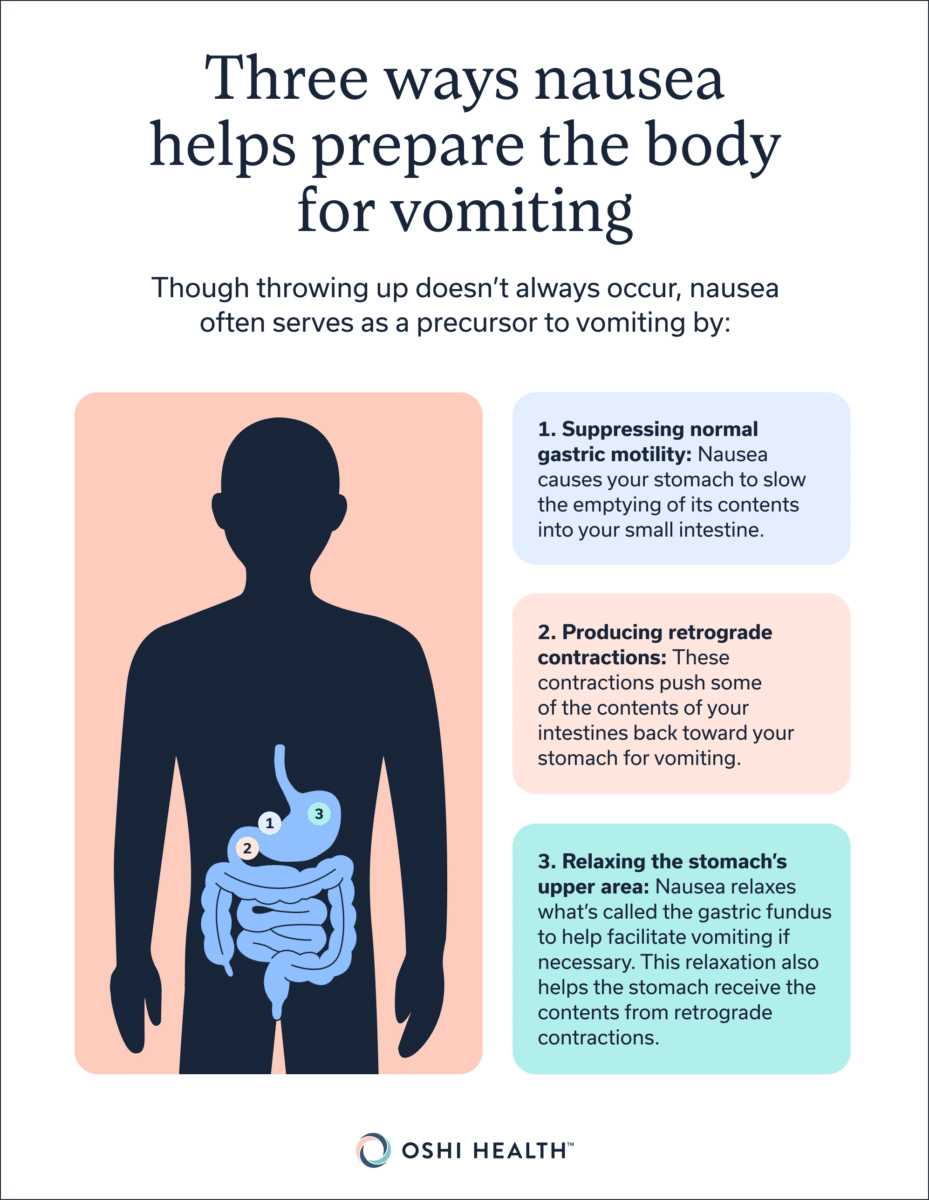
Though throwing up doesn’t always occur, nausea also serves as a precursor to vomiting by:
-
Suppressing normal gastric motility: Nausea causes your stomach to slow the emptying of its contents into your small intestine.
-
Producing retrograde contractions: These contractions push some of the contents of your intestines back toward your stomach for vomiting.
-
Relaxing the stomach’s upper area: Nausea relaxes what’s called the gastric fundus to help facilitate vomiting if necessary. This relaxation also helps the stomach receive the contents from retrograde contractions.
Why do I feel nauseous? Common causes
Now that we know the purposes of nausea, we can explore the common causes that can trigger that woozy feeling.
Infection
When you have a viral or bacterial infection, your immune system tries to come to your rescue. Nausea can be a way for your body to get you to eliminate the offending germs.
Digestive causes
Minor GI upset can cause nausea. The issue could be related to something you ate that didn’t agree with you, or temporary constipation, bloating, or acid reflux, just to name a few. Additionally some ongoing GI issues, such as gastroesophageal reflux disease (GERD) and irritable bowel syndrome (IBS) can lead you to feel nauseous regularly.
Nervous system causes
Your gut and brain communicate with each other via the gut-brain axis. So when you’re stressed, anxious, depressed, or feeling intense emotions, you might feel a bit nauseous. Additionally, some conditions affecting the nervous system can cause queasiness. Nausea could be a feature of the below example states:
-
Concussion
-
Epilepsy
-
Ménière’s disease
-
Migraine
-
Multiple sclerosis (MS)
-
Parkinson’s disease (PD)
-
Postural orthostatic tachycardia syndrome (POTS)
-
Traumatic brain injury
-
Vertigo
Of course, nausea alone does not mean you have any of the above conditions; it’s simply one potential symptom with many potential causes.
Substance use causes
Some substances can lead to an upset stomach as well. For example, too much alcohol irritates the stomach lining. Plus, a byproduct of alcohol called acetaldehyde can build up in the bloodstream and cause nausea.
Long-term or heavy cannabis use could also be the culprit. Cannabinoid hyperemesis syndrome (CHS) triggers severe nausea.
Even caffeine could be to blame, especially if you had a cup of joe on an empty stomach or consumed too much caffeine all at once.
Medication causes
Nausea is a side effect of many medications, too many to list. If you’re experiencing unexplained nausea, look at the side effects for any medications you take. If you suspect a drug is to blame, talk to your prescribing clinician. They may be able to switch your dose or change your medication altogether to address this unpleasant side effect.
Hormonal causes
Hormonal shifts can also cause nausea. For example, you may feel a bit queasy during the second half of your menstrual cycle when you’re in your luteal phase, especially when your estrogen and progesterone levels drop right before you get your period.
In perimenopause (aka the menopause transition), your reproductive hormones can fluctuate wildly before eventually declining as you reach your final menstrual period. These changes can also trigger nausea.
Pregnancy can cause morning sickness, though this type of nausea can show up at any time, not just in the a.m. A severe form of persistent nausea during pregnancy is called hyperemesis gravidarum. This is a reason to consult your clinician right away.
Additionally, insulin surges can lead to nausea by causing a drop in blood sugar. Your pancreas releases this hormone in response to glucose entering your bloodstream after a meal or snack. Insulin helps get glucose into your cells to be used for energy or stored in a different state for later.
Once glucose is in your cells and out of your bloodstream, your blood sugar returns to its baseline level. But when you have a large insulin release in response to a high-carbohydrate meal, your blood sugar can drop below baseline, leading to nausea and other unpleasant symptoms.
The gut-brain connection: How stress, anxiety, and nerves influence nausea
Your emotions can also trigger nausea because of how the gut and brain communicate with each other via the gut-brain axis. Basically, your stomach knows when you’re upset. To understand this, we have to unpack some components of the nervous system.
Your central nervous system (CNS) includes your brain, your spinal cord, and your autonomic nervous system (ANS). Your ANS controls the involuntary processes in your body. It manages your heart rate, blood pressure, breath rate, digestion, and even sexual arousal.
Your ANS has three branches:
-
Sympathetic nervous system (SNS): This is your”fight-or-flight” system, or your stress response.
-
Parasympathetic nervous system (PNS): This is your”rest-and-digest” system, or your calm response.
-
Enteric nervous system (ENS): This is an extensive network of millions of nerve cells along your GI tract’s walls. It controls digestive functions. Your ENS works independently and in coordination with your SNS and PNS.
You experience fight-or-flight when you’re stressed, anxious, or nervous. You experience rest-and-digest when you’re generally calm or feeling relatively normal during a typical day. These two modes of being operate somewhat in opposition to each other.
Obviously, when you’re in fight-or-flight mode, you’re not calm. But this also means that your body shuts down much of your rest-and-digest processes. It does this so that it can divert all resources toward helping you manage a potential threat.
If you’ve ever had that experience of feeling like you might throw up when you’ve received bad news, the nausea is a result of your fight-or-flight mode pressing pause on your rest-and-digest mode, which also affects your enteric nervous system.
Once the emotion passes, the nausea will clear up. But if you’re experiencing ongoing emotional distress or you have a history of trauma, you might face nausea more frequently from an overactivated fight-or-flight response.

What relieves nausea immediately: Quick-relief options
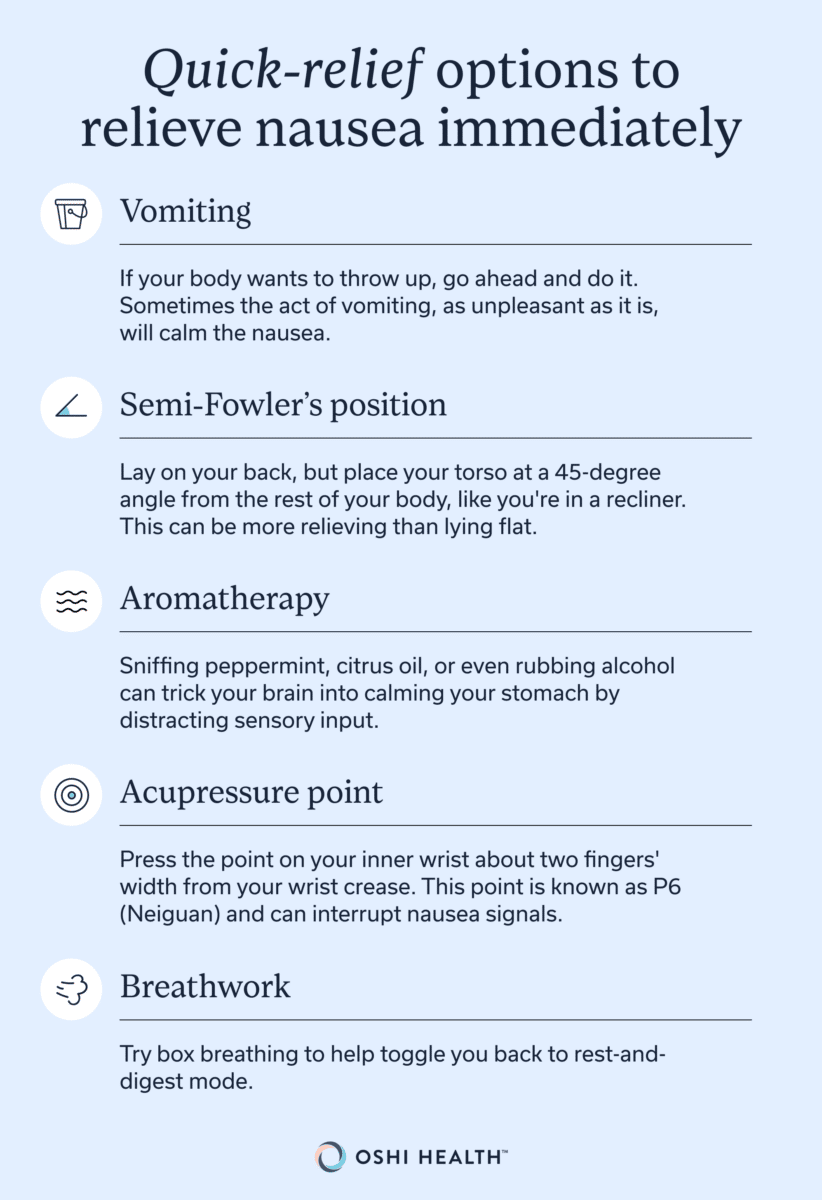
Now that you’ve got a better understanding of why nausea happens and what might be causing it, you might be wondering what you can do to calm your stomach. Here are a few options that can provide fast relief.
Vomiting
If your body wants to throw up, go ahead and do it. Sometimes the act of vomiting, as unpleasant as it is, will calm the nausea. Expelling the contents of your stomach may remove the offending irritant or toxin and get rid of your queasiness. Avoid forcing yourself to throw up, but don’t fight it.
Semi-Fowler’s position
The semi-Fowler’s position is when you lie on your back, but you place your torso at a 45-degree angle from the rest of your body. Think about how lying in a recliner works. The position is commonly used in settings where people receive chemotherapy for cancer, and research shows it’s more effective than lying flat.
Acupressure point
Nausea relief could be in sight by activating a pressure point on your wrist known as P6 (Neiguan). Pressing this point stimulates nerves to signal your brain to release feel-good chemicals that help interrupt nausea signals.
Press P6:
-
Turn one of your hands so that your palm faces up.
-
Place the first three fingers of your opposite hand across your wrist, with your ring finger at your wrist crease.
-
Locate the P6 point, which is under your index finger in the center of your wrist and between the two large tendons running up your forearm.
-
Remove your fingers and use your thumb to apply pressure.
-
Move your thumb in small circles at this point for a few minutes.
Aromatherapy
Generally, sniffing isopropyl alcohol (aka rubbing alcohol) isn’t recommended, but in the event of nausea, it can trick your brain into calming your stomach. It distracts sensory input and may calm neuropathways that are triggering the symptom.
How to sniff:
-
Grab an alcohol swab or dab rubbing alcohol on a cotton ball or pad.
-
Place it under your nose and inhale briefly.
-
Give yourself a break and repeat as necessary.
Breathwork
Focusing on your breath can help calm your mind from stress or anxiety, which can then help provide nausea relief. One inconspicuous technique is box breathing. This helps toggle you back to rest and digest mode.
Box breathing:
-
Picture a box.
-
Inhale for a count of four while picturing your breath moving up one side of the box.
-
Hold for a count of four at the top of the box.
-
Exhale for a count of four while picturing your breath moving down the box.
-
Hold for count of four.
-
Repeat as necessary.
Long-term management of nausea
If you have ongoing nausea or if it’s a frequent symptom for you and you don’t know why, talking to a knowledgeable clinician is a good idea. They can help figure out what might be causing your nausea and find ways to reduce your triggers.
Working with an Oshi Health provider
Since nausea can be caused by many factors, including issues where the gut and brain are having trouble communicating, you may benefit from coordinated, multidisciplinary support from a team of experts in gut-brain therapy, like those at Oshi Health.
Your care team might include a GI provider (a nurse practitioner or physician associate), a GI registered dietitian, and/or a gut-brain specialist or psychologist, all overseen by board-certified gastroenterologists. They collaborate to help you repair your gut-brain connection to soothe and manage GI conditions and symptoms, as well as your mental health.
Key Takeaways
-
Nausea can occur because of illness, a GI concern, a nervous system issue, an emotional response, and more.
-
Some DIY techniques can help calm nausea in the moment, but if you have ongoing queasiness, talking to a clinician is a good idea.
-
Oshi Health can help you understand why nausea is plaguing you and nurture your gut-brain connection via targeted, expert-backed therapies–to ease the symptoms.
FAQ
-
If you feel nauseated, a quick trick to try that’s often used in emergency rooms is to gently sniff rubbing alcohol, such as from a cotton pad or swab.
-
Yes, anxiety can cause nausea because the gut and brain communicate via the gut-brain axis. Stress or anxiety can temporarily halt some of your digestive processes, leaving you queasy. Calming your mind can help ease the sensation.
-
If you have nausea, take small sips of water if you can. Another option is to sip on ginger tea or a beverage with ginger extract.
-
Oshi is your partner in digestive health
Feel like your digestive concerns are running your life? You’re not alone—and we’re here to help you find lasting relief.
Oshi Health GI providers, gut-brain specialists, and registered dietitians work together to address your symptoms and find solutions that actually work for you.
Whether you’re dealing with chronic digestive issues or unpredictable symptom flare-ups, our GI specialists deliver:
✔ Personalized care plans tailored to your lifestyle
✔ Science-backed strategies to calm your gut
✔ Compassionate, whole-person care
✔ And so much more!
Ready to take control of your gut health?