Every point solution in the benefits stack gets measured the same way: cost per member, engagement, satisfaction. Virtual GI care usually gets sorted into that bucket too — and that’s the problem. Programs built to actually move GI cost trends aren’t operating like point solutions; they’re replicating a center of excellence model that academic medical centers use for complex GI care. Comparing the two on a PEPM spreadsheet misses what separates real clinical outcomes from added-on support.
The specialty health benefits market has shaped a common mental model for evaluating virtual care programs: as point solutions. Discrete interventions that address a defined condition category, contracted at a per-member-per-month rate, added to a benefits stack alongside other point solutions covering mental health, musculoskeletal conditions, and chronic disease management.
That model worked reasonably well for many categories. It does not work for virtual GI care, at least not the version of it that can actually move employer GI cost trends.
What point solutions are actually designed to do
Most digital health point solutions are designed to support patients alongside their existing care. They provide education, coaching, symptom tracking, and care navigation. They help employees find providers, understand their benefits, and access resources. This is genuinely useful, and these programs serve a real function in a well-designed benefits portfolio. But they are bound by the same limitations as the underlying care system they sit on top of: A care navigation program cannot diagnose. It cannot prescribe. For a patient with unresolved GI symptoms who has already cycled through primary care and a specialist referral without getting answers, a navigation tool that helps them find the next appointment does not solve the underlying problem.
What the right comparison actually is
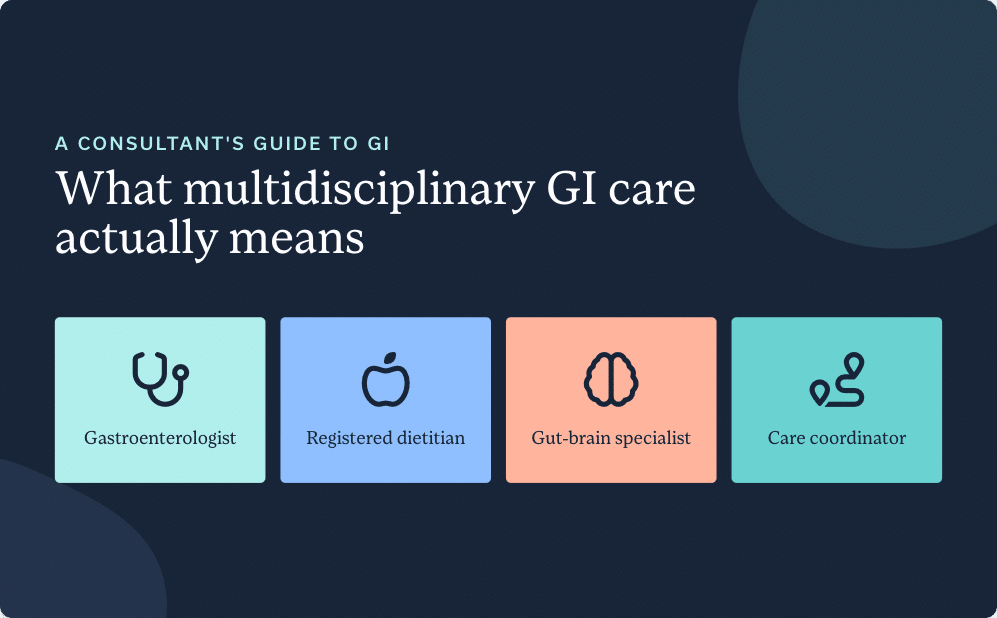
The right comparison for a clinician-led virtual GI program is not other digital health point solutions. It is coordinated care delivered by employed GI specialists, registered dietitians with GI-specific expertise, behavioral health clinicians trained in gut-directed therapies, and care coordinators who manage the full patient journey. That model is what clinical guidelines recommend for the management of IBS, IBD, and other complex GI conditions.
Peer-reviewed research bears this out directly: multidisciplinary care integrating gastroenterologists, dietitians, and behavioral health specialists consistently outperforms usual, single-modality care on symptom management, quality of life, and cost, a finding replicated across IBS, IBD, and liver disease populations in independently analyzed claims data.
Why this distinction changes the evaluation entirely
When you recognize that a well-designed virtual GI program is delivering center of excellence level care rather than point solution level support, the evaluation criteria change. Price per member becomes less relevant than clinical depth and outcomes methodology. Enrollment rates become less relevant than what happens to enrolled members’ claims. Satisfaction scores become a baseline expectation rather than the primary evidence of value.
The programs that consistently demonstrate 60-70% reductions in emergency visits, 50%+ reductions in hospital admissions, and $6,000 to $11,000 in per-member cost savings in independently validated claims analyses are producing these outcomes because they are delivering a fundamentally different level of clinical care.
This is a welcome development in the benefits market.