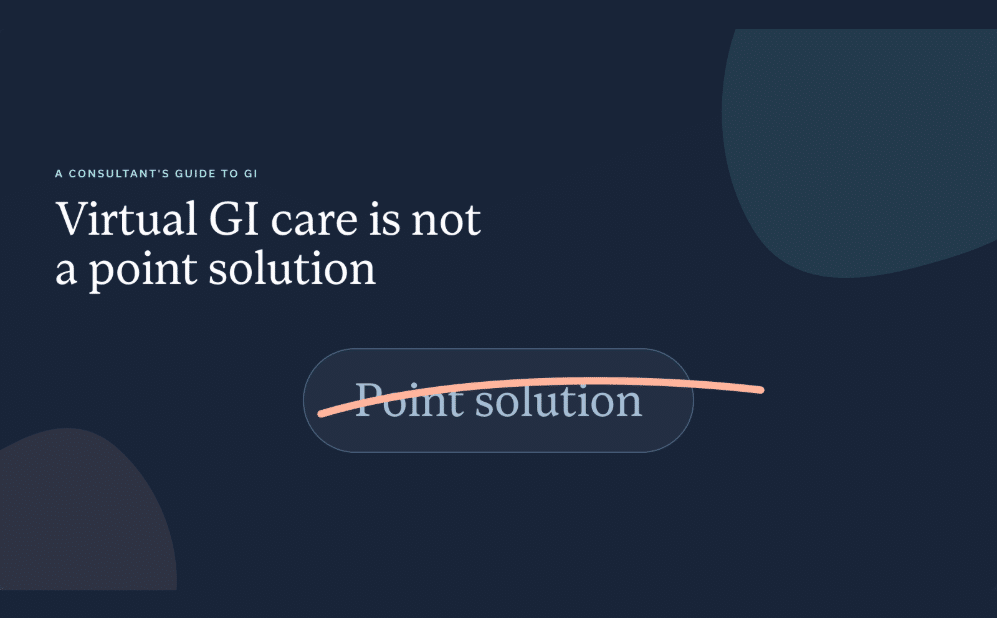
GI conditions have quietly become a top-3 category in employer health spend. Between IBS, IBD, and GERD, these conditions drive a massive share of specialist visits and avoidable ER utilization. When you’re vetting a vendor, the real differentiator is their clinical architecture: Two models, two very different outcomes.
GI conditions have quietly become a top-3 category in employer health spend. Between IBS, IBD, and GERD, these conditions drive a massive share of specialist visits and avoidable ER utilization. It’s no wonder that “virtual GI” is becoming a standard line item in digital health portfolios.
But as consultants, you know that category labels can be misleading. When you’re vetting a vendor, the real differentiator lies in the clinical architecture.
What the Peterson Health Technology Institute found
The 2026 PHTI independent digital health evaluation of virtual gastrointestinal care solutions made an explicit key distinction. The report divided the virtual GI market into two categories: wraparound solutions, which complement a patient’s existing care with support services, and clinician-led solutions, which integrate GI medical management directly within the program. The clinical outcomes and cost savings documented in the assessment are not evenly distributed between these two categories.
Model 1: The Coach (Wraparound Care)
Coaches are generally highly structured and focused on lifestyle modifications. They’re helpful in creating a plan for members, and can offer accountability. However, they generally sit upstream of clinical care, and lack the training to handle the complexity and nuance of GI conditions, including flare-ups and medication management. Once the member needs a diagnosis, medication management, or support for gut-brain comorbidities, the “virtual” part is over, they’re back in the traditional system, facing the same old 3-month wait times and in the ER cycle when flareups occur.
Model 2: The Clinical Center of Excellence (Multidisciplinary Care)
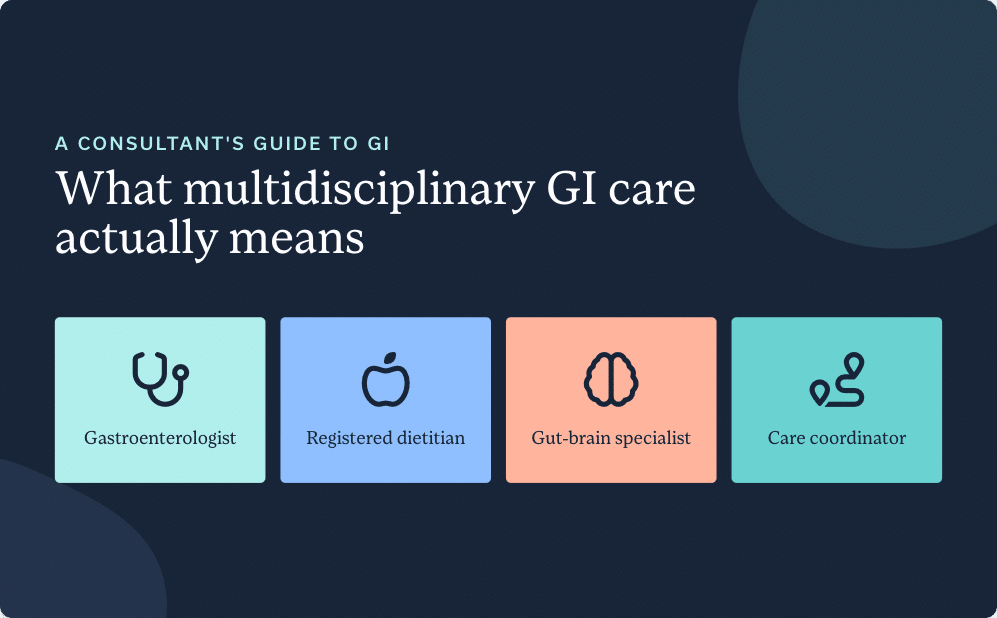
This model changes the game. It treats the condition rather than just navigating it. It brings GI physicians, GI-trained dietitians, and behavioral health clinicians onto one team, working from one shared care plan. Most importantly, they’re accountable for the clinical outcome.
Before you land on a recommendation, ask these five questions:
- “Can this program diagnose and treat, or do you refer out for both?”
If they refer out, they’re a low-acuity tool, not a clinical solution. - “Is behavioral health integrated into the GI care plan, or is it a separate point solution?”
The gut-brain connection is real. If the programs aren’t clinically integrated, you’re only treating half the patient. - “What happens after the first interaction?”
A coaching model stops when the patient drops off. A clinical model stays until the patient has their symptoms under control. - “What is the actual care team composition?”
“Multidisciplinary” is often used loosely. Look for a team of clinicians across multiple disciplines practicing at the top of their license, not just health coaches. - “Show me the outcomes data beyond satisfaction scores.”
Engagement is easy to measure. Symptom severity reduction, medication optimization, and ED utilization changes are what actually move the needle for your clients’ CFOs.
The practical implication for consultant recommendations
When advising employer clients on virtual GI solutions, the consultants who use the COE benchmark are going to recommend programs that their clients can actually hold accountable for outcomes. Programs like Oshi Health, which operate as virtual GI centers of excellence with national scale, should be evaluated on the same dimensions as adding a high-performing specialty care relationship to a network: clinical credentials, care model design, outcomes methodology, and population-level impact. Programs that cannot meet that standard belong in a different evaluation conversation.
The benchmark you use determines the questions you ask. The questions you ask determine the programs you recommend. And the programs you recommend determine whether your employer clients actually bend their GI cost curve or simply add another line item to their benefits guide.