



You might be wondering, “Why am I suddenly lactose intolerant?” if you used to enjoy ice cream or lattes, but now they’re making you feel bloated, gassy, or worse. It’s possible to develop lactose intolerance, even if you used to tolerate it well.
You slathered your bagels in cream cheese, ordered milkshakes at the drive-thru, or started your days with cereal and milk. But now those things come with nausea, bloating, diarrhea, and other uncomfortable symptoms. In short: dairy was your friend, but now it’s your foe. What gives?
I can relate. When I suddenly developed lactose intolerance in my 20s, I was very confused. I’d spent my whole childhood gulping a glass of milk alongside dinner. Suddenly, even the slosh of cream in my coffee brought on a tummy ache.
Reacting to dairy is pretty common, but it’s not always caused by a primary lactose intolerance. Sometimes other factors can be at play, such as gut infections or another health condition.
This was the case for me. I saw a dietitian who helped guide me through a low-lactose diet, which I followed for a couple of years. I was able to heal from lactose intolerance once I addressed the underlying cause, which for me was celiac disease and small intestinal bacterial overgrowth (SIBO). Now, I can eat ice cream to my heart’s content!
This article will help you understand why dairy may suddenly be causing digestive symptoms, including primary and secondary lactose intolerance, and other possible explanations.
Why am I suddenly lactose intolerant?
If you’re reacting to dairy, then your symptoms might feel abrupt. But the underlying cause may be gradual, temporary, or even unrelated to lactose.
It’s possible to develop a lactose intolerance later in life. Lactose is a sugar that’s found in milk and other dairy products. Lactase is the enzyme in your small intestine that breaks it down.
If lactose isn’t properly broken down, it can cause gas, bloating, cramps, diarrhea, and other symptoms.
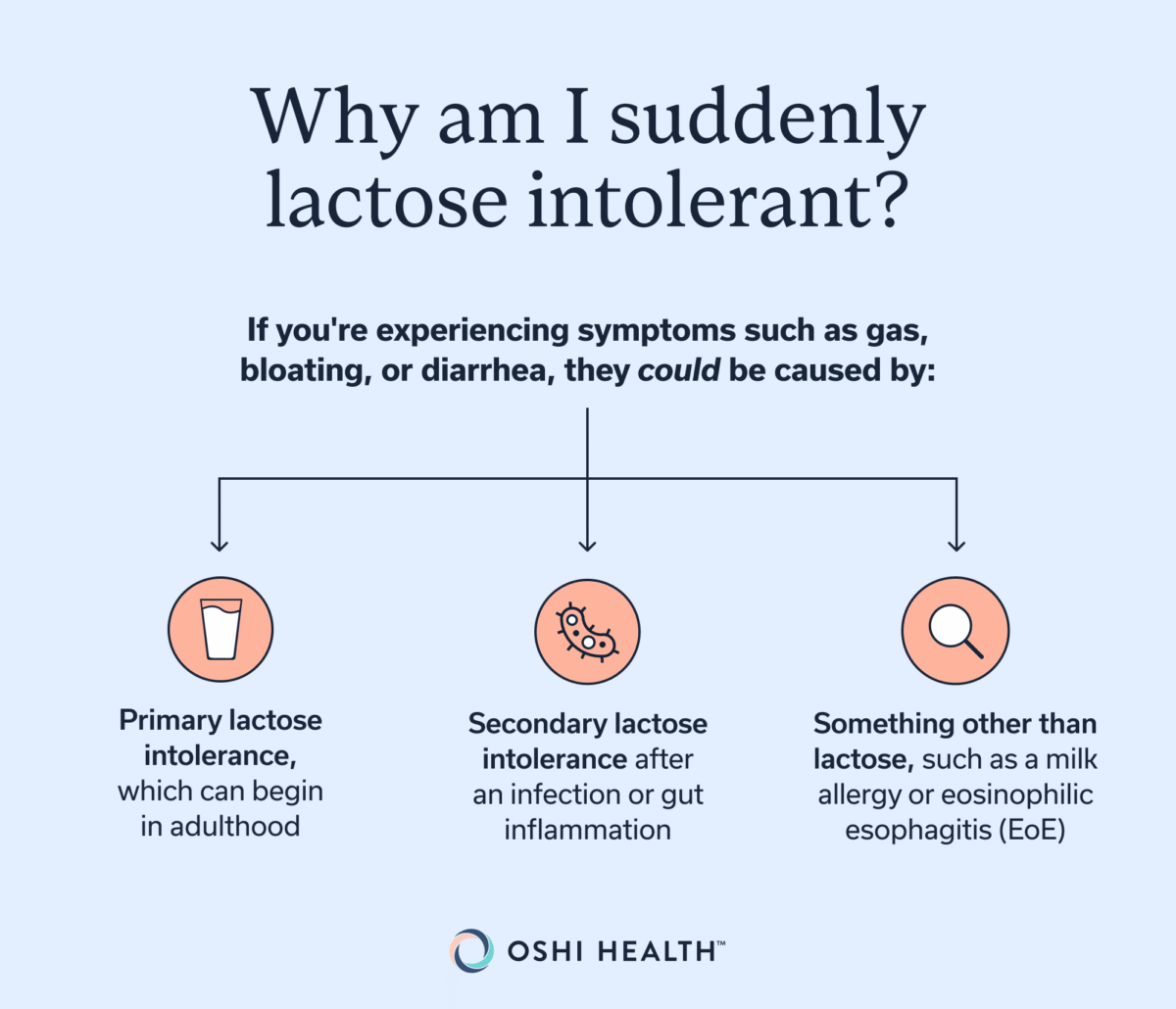
Lactose intolerance can develop if something’s messing with this process. This could be:
- Primary lactose intolerance, which is gradual adult-onset lactose intolerance
- Secondary lactose intolerance, which is symptoms or sensitivity after an infection or gut inflammation
- Symptoms caused by something other than lactose, such as a milk allergy or eosinophilic esophagitis (EoE)
Primary lactose intolerance
“Primary lactose intolerance is the most common form seen in adults,” says Angie Sadeghi, MD, a gastroenterologist based in California.
This type of lactose intolerance develops due to a genetically programmed decline in lactase production, usually after childhood.
It’s estimated to affect 57 to 65% of the global population, per Nutrition Research. Primary lactose intolerance is more common among people of Asian, Native American, and African heritage, and less common among people of northern or western European heritage, per MedlinePlus.
“Once genetically determined lactase decline occurs, it does not typically reverse,” says Dr. Sadeghi. (Don’t worry, though—you don’t necessarily have to say goodbye to dairy. More on that below!).
Secondary lactose intolerance
Secondary lactose intolerance occurs when something damages or inflames your small intestine (where lactase is produced), and temporarily reduces lactase activity. This can make your body less efficient at breaking down lactose and lead to symptoms.
Some potential causes of secondary lactose intolerance include:
- Any GI illness that causes diarrhea
- Celiac disease
- Crohn’s disease
- SIBO
- Small intestine infection
- Surgery to the small intestine
“Unlike primary lactose intolerance, this form is often reversible once the underlying cause is treated,” says Dr. Sadeghi.
Lactose intolerance symptoms and timing
If you’re wondering “why am I suddenly lactose intolerant,” then your first step is to pay close attention to whether your unexplained GI symptoms happen after eating lactose specifically (and no, it’s not the same as dairy!), or after many different foods.
Some of the most common symptoms of lactose intolerance include:
- Bloating
- Constipation
- Cramps
- Diarrhea
- Farting
- Gas
- Nausea
- Stomach rumbling
- Vomiting
It’s equally important to pay attention to timing. If your symptoms are due to lactose intolerance, then they will occur 30 minutes to two hours after consuming high-lactose foods, per MedlinePlus.
However, this timing can vary based on factors like your portion size. You might tolerate a small amount of lactose, whereas bigger portions might trigger symptoms. Your symptoms might also worsen during illness or if you have an infection that’s exacerbated.
How to know if you’re lactose intolerant—or if something else is going on
The gold standard for diagnosing lactose intolerance is the hydrogen and methane lactose breath test (LBT), combined with a genetic test that looks for the lactase-gene polymorphism, per the Journal of Translational Medicine.
However, a health professional must interpret the LBT carefully. It can’t distinguish between a temporary or permanent lactose intolerance on its own. It also doesn’t account for symptoms, and false negatives can occur.
Many GI providers and dietitians therefore recommend a temporary elimination diet. This can help identify if lactose, another specific ingredient, or even environmental factors like sleep or stress, could be triggering your symptoms.
“A two-week lactose-free dietary trial is often sufficient to support the diagnosis,” says Dr. Sadeghi. If your symptoms come back after consuming lactose again, this suggests a lactose intolerance, she explains.
At Oshi Health, clinicians take the approach that it’s equally important to rule out other causes of your symptoms, in case lactose intolerance isn’t your main issue but rather one among several.
Investigations may be done with blood tests or other GI testing, depending on your symptoms and clinical history.
Dairy foods that are most likely to trigger symptoms
It’s important to understand that lactose and dairy aren’t the same. Lactose is a sugar that’s found in dairy products, but in variable amounts.
Some dairy foods, like hard cheeses and butter, contain virtually no lactose because it’s removed during processing.
Other dairy foods—especially the more liquid, creamy, or softer ones—can contain high levels of lactose.
“Lactose intolerance is often misunderstood as an all-or-nothing diagnosis,” says Dr. Sadeghi. In reality, most people with lactose intolerance can handle 10 to 15 grams (g) of lactose daily, per Nutrients.
Everyone’s different, though, so pay attention to your own symptoms. A dietitian can help you figure out your personal tolerance level.
Some high lactose foods include:
| Food | Serving size | Lactose per serving | Low-lactose swaps |
| Milk | 1 cup | 11 g |
|
| Latte | 1 cup | 10 g |
|
| Ice cream | 2/3 cup | 5.5 g |
|
| Cream | 1 tablespoon | .5 g |
|
| Cream cheese | 2 tablespoons | 1 g |
|
You’ll also want to watch out for hidden sources of lactose. Some common ones are:
- Baked goods
- Certain protein powders (whey protein concentrate)
- Creamy sauces
- Processed snacks
- Salad dressings
- Some medications or supplements
- Soups

What to do if dairy suddenly bothers you
If dairy suddenly bothers you, then consider making an appointment with a GI clinician or dietitian, like those who work with Oshi Health.
It’s worth getting professional help to get to the bottom of what you think might be lactose intolerance, but could actually be something else.
After all, you don’t want to cut out foods you love (like cheese or milk chocolate!) if lactose isn’t truly your problem—or if your lactose intolerance could be solved by treating another condition, as was the case for me personally.
If your GI clinician or dietitian suspects lactose intolerance, they might start with a short, structured diet. This will involve:
- Tracking food and symptoms for a few weeks
- Reducing high-lactose foods temporarily, and monitoring symptoms
- Keeping meals otherwise consistent
- Reintroducing high-lactose foods slowly, and monitoring symptoms
- Taking note of lactose portion size and any symptom timing
I feel like I’m seen and heard. I feel like if I bring up an issue I’m having, I’m not going to be dismissed or ignored. I do think in medicine that is important. I feel like the older I get, that becomes more important because I need to be able to trust the GI individual. I need to be able to know that if something does arise, I can tell them and it will be taken care of and we can work on it together because we’re a team. And I feel that way with Oshi.
— Ariana L.
Read More About Ariana's Oshi ExperienceLactose intolerance treatments and longer-term management
Your personal lactose intolerance treatments (and how long you need them for) will depend on whether you have primary or secondary lactose intolerance.
Primary lactose intolerance treatment
The treatment for primary lactose intolerance is a lifelong low-lactose diet. “The goal is to identify individual tolerance patterns and build a sustainable dietary approach that prioritizes comfort and long-term health,” says Dr. Sadeghi.
This doesn’t mean cutting out all dairy foods, but rather sticking to lower lactose options (for instance, swapping out soft cheeses for hard ones) and not overstepping your personal tolerance level on a daily basis.
Your lactose tolerance level may change over time. Working with a registered dietitian can help you monitor this. A dietitian can also help you explore more plant-based, low-lactose meal ideas, so your diet doesn’t feel too restrictive.
Restricting your dairy intake can also put you at risk of vitamin and nutrient deficiencies if you’re not compensating correctly. However, “calcium, vitamin D, protein, and vitamin B12 can all be obtained through plant-based foods and fortified alternatives,” says Dr. Sadeghi.
Your dietitian may recommend strategies, such as:
- Eating vitamin-fortified plant-based foods
- Eating smaller portion sizes of lactose-containing foods
- Finding lactose-free swaps for dairy products
- Monitoring and treating vitamin and nutrient deficiencies
- Taking lactase supplements, which can help you break down the lactose in foods like milk and ice cream, and can reduce lactose-related symptoms
- Taking probiotics, if recommended
Secondary lactose intolerance treatment
Secondary lactose intolerance is also treated with a low-lactose diet, but the important distinction is that this diet is not meant to last forever.
“Secondary lactose intolerance is often temporary,” says Dr. Sadeghi. “When the intestinal lining heals, such as after infectious gastroenteritis, treatment of celiac disease, or control of inflammatory bowel disease, lactase activity may recover, and symptoms may resolve.”
In the short term, avoiding lactose can help manage your symptoms so you feel better.
In the long-term, identifying and treating your underlying cause is essential. Once your small intestine heals, you can reintroduce lactose and follow a less-restrictive diet. A dietitian can help during this process, which can feel scary if you’ve avoided lactose for a long time.
When to seek care from a GI provider
It’s worth seeking care from a GI provider, like those at Oshi Health, if you’ve developed new or persistent symptoms, such as diarrhea, constipation, or bloating. Be sure to mention during your appointment if you’ve noticed a pattern that links your symptoms to lactose.
Some red flags that something else might be going on include:
- Blood in the stool
- Fever
- Persistent abdominal pain
- Weight loss
“Persistent or atypical symptoms should not be assumed to be lactose intolerance without evaluation, as accurate diagnosis is essential for effective treatment,” says Dr. Sadeghi.
In other words, new or severe symptoms shouldn’t be automatically blamed on lactose without checking.
The Oshi team can support you with a GI provider evaluation and testing, so you can get to the bottom of what’s causing your symptoms. You may also see a registered dietitian, who can guide you through a low-lactose diet and identify your personal tolerance levels. Gut-brain specialists are also available to support you if your symptoms are tied to stress.
Ultimately, lactose could be the cause of your symptoms, a clue to another digestive issue, or even a red herring. Working with a multidisciplinary GI care team can help you get back to feeling your best.
Key takeaways
- Can you develop lactose intolerance later in life? The simple answer is yes.
- You can develop primary lactose intolerance as a teen or adult, which is a genetic decline in the lactase enzyme and requires a long-term low-lactose diet.
- Other health conditions and infections can also cause secondary lactose intolerance, which is temporary and due to small intestine damage.
- Working with a GI care team is essential to diagnose and manage lactose intolerance. It’s important to get the right explanation for your symptoms, so that you don’t adopt an unnecessarily restrictive diet or risk nutritional deficiencies, and also so your underlying cause can be treated.
Frequently asked questions (FAQs)
Can you be lactose intolerant but still tolerate yogurt?
Yes, you can be lactose intolerant but still tolerate yogurt. Some people with lactose intolerance can tolerate yogurt better than milk. This is likely because, as a fermented food, the bacterial strains in yogurt help break down lactose in your gut, according to the Journal of Dairy Research.
Is lactose-free milk okay if I have a milk allergy?
No, it’s not okay to drink lactose-free animal milk if you have a milk allergy, but you should be able to substitute any plant-based milk. People with a milk allergy react to proteins found in milk, not sugars like lactose. These proteins are still present in lactose-free animal milk and can cause a dangerous reaction if ingested.
Can lactose intolerance start after taking antibiotics?
It’s possible to develop lactose intolerance after taking antibiotics. This is a case of secondary lactose intolerance, meaning that it’s temporary and should resolve once your gut heals.
Can lactose intolerance symptoms happen the next day?
Lactose intolerance symptoms are unlikely to start the next day. Typically, they begin 30 minutes to two hours after consuming lactose, per MedlinePlus. It’s possible that you might still feel the effects of these symptoms the following day, though.
Take charge of your gut health with expert dietary support
Your nutrition plays a powerful role in your digestive well-being. But figuring out what to eat can be overwhelming, especially if you’re dealing with chronic or occasional GI symptoms.
Oshi’s registered dietitians have specialized knowledge in all GI symptoms and conditions. They work closely with you to:
✔ Identify foods that help—not hurt—your gut
✔ Develop personalized meal plans that fit your lifestyle
✔ Guide you through small, sustainable changes for symptom relief
✔ And so much more!
Ready to make mealtimes less stressful and feel in control again?