

Have you ever noticed that when you have to take a test, go to a job interview, give a presentation, or have a difficult conversation with a loved one, your stomach suddenly decides to betray you? Maybe you have that stomach-dropping sensation, or you feel queasy and nauseous. If you’ve ever wondered, Does anxiety cause nausea? The answer is yes.
When stress or anxiety rear up, so can the contents of your stomach. In emotionally-charged situations, you might experience a wide range of GI symptoms, including nausea, cramps, bloating, diarrhea, abdominal pressure, or vomiting. Many times the situation is temporary, and when the anxious moment passes, your gastrointestinal (GI) tract calms too. Other times, chronic stress or anxiety can lead to longer-lasting GI symptoms.
Whether short-term or ongoing, anxiety-related nausea can be frustrating. The last thing you want when feeling anxious is to have to worry about your stomach, too.
Why would your mental health affect your digestive tract in the first place? The answer: They’re connected, and your gut and your brain communicate with each other via your nervous system. In response to a perceived threat, your nervous system puts all your bodily resources toward managing it, placing some of your digestive functions on pause. This is when queasiness can ensue.
In this article, we explore the connections between anxiety and nausea, anxiety management techniques, how to stop being nauseous even in stressful situations, and more.
Can anxiety cause nausea? How the gut-brain axis works
At the heart of the connection between anxiety and nausea is the gut-brain axis. In short, this is how your gut and brain communicate. Understanding this link requires knowledge of some nervous-system basics. This is where that old 1980s NBC catchphrase”The more you know” comes in, because the more you know about how the nervous system works, the more you can do to control it.
So let’s cover a few terms, starting with your central nervous system, which consists of your brain, spinal cord, and autonomic nervous system (ANS). Your ANS controls the involuntary processes in your body. Think heart rate, blood pressure, temperature, breathing, digestion, sexual arousal, and more. It has three divisions.
Three divisions of the ANS:
-
Sympathetic nervous system (SNS): This system involves your stress response, also called”fight or flight.” When it activates, you might get that adrenaline rush sensation, feel warm and sweaty, and notice your heart rate and breath rate increase.
-
Parasympathetic nervous system (PNS): This system involves your calm response, also called”rest and digest.” When it activates, you feel at ease, and your body can focus on things like digesting nutrients.
-
Enteric nervous system (ENS): This is an extensive network of millions of neurons along your GI tract’s walls. It manages digestive functions, including gastric secretions and motility (the movement of food and waste). It works independently and in tandem with the other branches of your ANS.
Think about the SNS and PNS as a switch. Now let’s imagine you have to take an important test or give a speech at an event, and you’re getting that butterflies-in-the-stomach feeling. Your nervous system has toggled to the fight-or-flight position. When this happens, it shuts off much of your rest-and-digest processes, affecting the enteric nervous system.
Fight-or-flight is a survival mechanism. Sure, you’re just trying to get through the hypothetical test or speech. But our ancient ancestors had other problems. They faced threats from predators and had to fight or flee, depending on the situation. So their bodies would temporarily pause unnecessary functions to ensure all energy resources went to handling the immediate threat.
Even though you’re not in physical danger when taking a test or speaking publicly, your body can still perceive the situation as a threat, triggering a physiological response that locks down your digestive processes. This may result in saying bye-bye to your breakfast if nausea or vomiting ensues. The good news is that if you learn the tools (we have tips below), you can toggle your nervous system back to rest-and-digest mode, keeping you calmer in stressful moments and easing digestive upset.
Keep in mind that the gut-brain connection can also work in reverse. Not only does anxiety affect your digestive tract, but your digestive tract can contribute to anxiety, especially if you have an underlying GI condition or a disrupted gut microbiome.
What anxiety-related nausea feels like vs other types
You might be wondering how to tell the difference between anxiety-driven nausea and nausea from other causes, and the answer might be found in the patterns you notice regarding timing and symptoms.
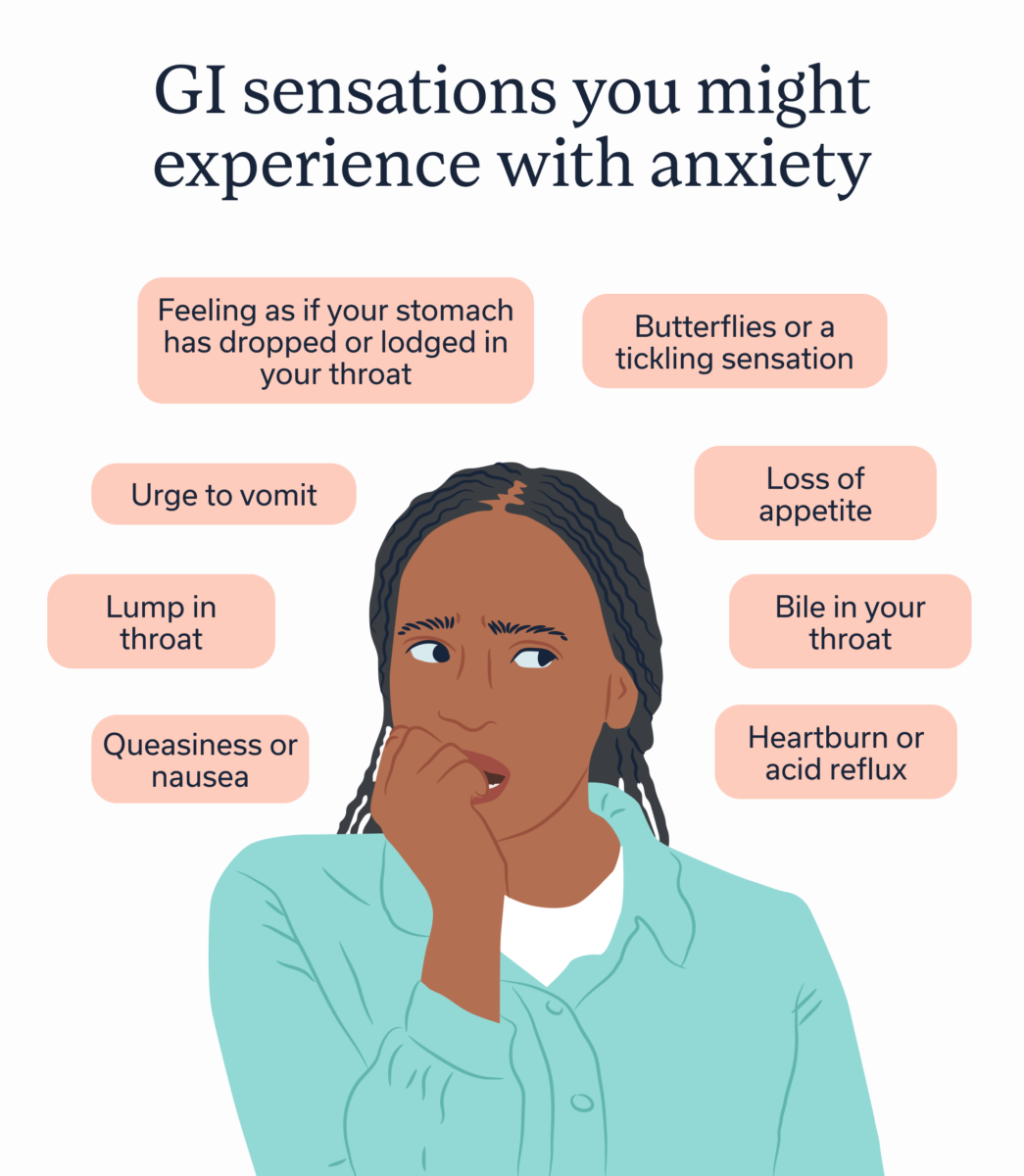
GI sensations you might experience with anxiety:
-
Queasiness or nausea
-
Lump in throat
-
Feeling as if your stomach has dropped or is lodged in your throat
-
Urge to vomit (with or without actually throwing up)
-
Loss of appetite
-
Butterflies or a tickling sensation
-
Bile in your throat
-
Heartburn or acid reflux
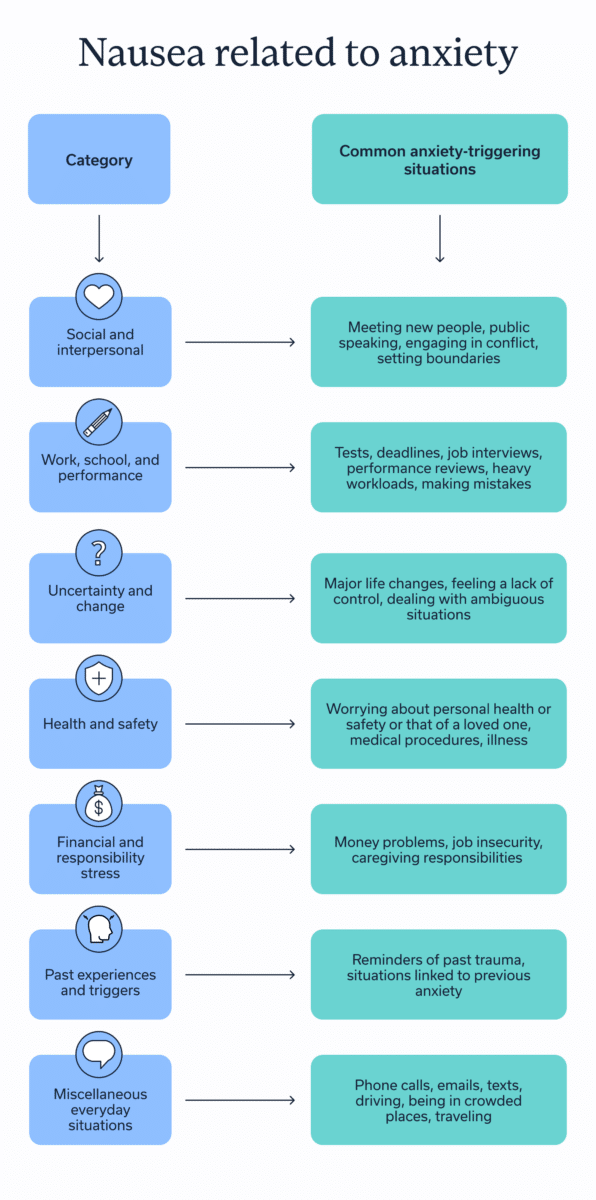
Of course, these sensations are common with other issues, including several GI conditions, acute illnesses such as food poisoning or the stomach flu, and motion sickness. So you might have to factor in timing. Do you tend to feel these sensations only in relation to certain situations, such as the examples listed in the table below? If so, you might be experiencing nausea related to anxiety.
| Category | Common anxiety-triggering situations |
| Social and interpersonal | Meeting new people, making small talk, public speaking, being judged or criticized, fearing rejection, engaging in conflict or confrontation, setting boundaries in relationships, and facing dating or relationship uncertainty (including a breakup, separation, or divorce) |
| Work, school, and performance | Taking tests, managing deadlines, going to a job interview, sitting in a performance review, facing a heavy workload, fearing or making mistakes, starting a new job or position, comparing yourself to coworkers or peers |
| Uncertainty and change | Facing major life changes (including moving), feeling a lack of control over your life, dealing with ambiguous situations |
| Health and safety | Worrying about personal health or that of a loved one, fear of illness or injury, facing medical procedures, worrying about a loved one’s safety |
| Financial and responsibility stress | Facing money problems, worrying about job insecurity, caregiving responsibilities for aging parents, or young children |
| Past experiences and triggers | Encountering reminders of past trauma, facing situations linked to previous anxiety |
| Miscellaneous everyday situations | Taking phone calls or answering emails or texts, driving or commuting, being in crowded places, traveling |
Diagnosis and testing: Is it anxiety, a GI condition, or both?
If you’re unsure whether your nausea symptoms are related to anxiety, a GI condition, or both, a knowledgeable care team can help you figure it out.
Some GI conditions share a two-way relationship with anxiety, where anxiety can worsen the GI condition, or the GI condition can contribute to anxiety, creating a vicious cycle. But just because you have anxiety and nausea does not automatically mean you have one of these conditions. They’re just worth investigating if your nausea does not resolve or returns frequently.
GI conditions with links to anxiety:
-
Inflammatory bowel disease (IBD): including Crohn’s disease and ulcerative colitis

Treatment options: how to stop being nauseous right now
If you need immediate strategies in the moment when anxiety triggers nausea, here are a few evidence-based techniques.
Acupressure point
You have a pressure point on your wrist known as P6 (Neiguan). Pressing this point stimulates nerves that tell the brain to release feel-good chemicals that help interrupt nausea signals.
How to do it: To find P6, turn one of your hands so that your palm faces up. Place the first three fingers of your opposite hand across your wrist, with your ring finger at your wrist crease. The P6 point is under your index finger, located in the center of your wrist and between the two large tendons running up your forearm. Remove your fingers and use your thumb to apply pressure. Move your thumb in small circles at this point for a few minutes.
Aromatherapy
A trick often used in the emergency department is gently sniffing isopropyl alcohol (aka rubbing alcohol). This method distracts sensory input and may calm the central nervous system or regulate other neuropathways that are triggering the nausea.
How to do it: Grab your first aid kit and reach for an alcohol swab or dab rubbing alcohol on a cotton ball or pad. Place under your nose and inhale briefly. You should notice relief within about four minutes. Give yourself a break and repeat as necessary. Pro tip: Carry eyeglass lens wipes or alcohol swabs in your pocket or purse when you’re out and about.
Breathwork
Focusing on your breath can help calm anxiety, which can then help provide nausea relief. One easy-to-do, anywhere, inconspicuous technique is box breathing. This helps flip the switch from fight or flight to rest and digest.
How to do it: Picture a box. Inhale for a count of four while picturing your breath moving up one side of the box, hold for a count of four at the top of the box, exhale for a count of four while picturing your breath moving down the box, hold fora count of four, then repeat as necessary.
Anxiety management techniques for long-term nausea relief
If you have ongoing or frequent anxiety that tends to trigger nausea, working with a licensed behavioral health provider who specializes in brain-gut behavioral therapy (BGBT), like the gut-brain specialists at Oshi Health, can help.
Examples of therapies:
-
Cognitive-behavioral therapy for GI (CBT-GI): CBT helps you analyze thought patterns that may trigger anxiety, and teaches you how to reframe them. CBT-GI helps you do this in the context of GI conditions and symptoms.
-
Gut-directed hypnotherapy. Hypnotherapy uses clinician-guided hypnosis to improve gut-brain communication, which can ease GI symptoms, such as nausea.
-
Mindfulness. This approach helps someone focus on the present and accept thoughts and feelings, which can help ease stress and anxiety. Gut-brain specialists often employ guided meditations, among other activities, to promote mindfulness.
-
Breathing techniques. Mindfulness techniques sometimes use breathwork, such as diaphragmatic breathing, to help you tap back into your rest-and-digest mode when you notice you’ve slipped into fight-or-flight mode. The box breathing method mentioned above is just one example of a breathwork technique, but your provider may suggest other methods to practice regularly.
What about medications?
In some cases, prescriptions may be needed to address anxiety and nausea. For example, anti-nausea medications can help in the short term. But they shouldn’t be taken regularly. Additionally, medications, including neuromodulators, can help improve communication between your brain and gut, often leading to an improvement in symptoms.
When to seek care: red flags for nausea, even if you have anxiety
Sometimes nausea requires urgent care. Seek medical attention right away if you experience the following:
-
Ongoing vomiting that won’t resolve
-
Ongoing nausea that prevents you from keeping food and fluids down
-
Vomiting with fever or severe abdominal pain
Working with an Oshi health provider
Since nausea and anxiety share a complex relationship and are affected by many other factors, you may benefit from coordinated, multidisciplinary support from a team of experts in gut-brain therapy, like those at Oshi Health.
Your care team might include a GI provider (a nurse practitioner or physician associate), a GI registered dietitian, and/or a gut-brain specialist or psychologist, all overseen by board-certified gastroenterologists. They collaborate to help you reroute your gut-brain connection to soothe and manage chronic GI conditions as well as your mental health.
Key Takeaways
-
Anxiety can trigger nausea because the autonomic nervous system toggles between two different states: fight or flight and rest and digest.
-
Additionally, the brain and gut communicate through the gut-brain axis, with the health of each affecting the other.
-
If you experience nausea with anxiety, Oshi Health can help you nurture your gut-brain connection via targeted, expert-backed therapies—to ease the symptoms of both.
FAQ
-
If you are experiencing nausea from anxiety, you can use techniques that help you switch from your stress response (fight or flight) to your calm response (rest and digest). One technique is box breathing: Inhale, then hold, exhale, then hold–for a count of four each. Repeat as needed. Other techniques focus on easing nausea symptoms. These include pressing an acupressure point on your wrist or briefly sniffing rubbing alcohol.
-
Take notice the next time you experience nausea. Do you also experience signs of fight or flight, such as an adrenaline surge or increased heart rate, breath rate, and temperature? If so, anxiety might be the culprit for your nausea.
-
The 3-3-3 rule for anxiety is a technique you can use in the moment to help calm you. This is a grounding technique which decreases acute anxiety by shifting attention from anxious thoughts to present moment awareness and focus with the aid of one’s senses. Name three things you see, followed by three things you hear. Then move three body parts. The process helps you focus on the present, rather than on anxious thought patterns.
Oshi is your partner in digestive health
Feel like your digestive concerns are running your life? You’re not alone—and we’re here to help you find lasting relief.
Oshi Health GI providers, gut-brain specialists, and registered dietitians work together to address your symptoms and find solutions that actually work for you.
Whether you’re dealing with chronic digestive issues or unpredictable symptom flare-ups, our GI specialists deliver:
✔ Personalized care plans tailored to your lifestyle
✔ Science-backed strategies to calm your gut
✔ Compassionate, whole-person care
✔ And so much more!
Ready to take control of your gut health?