



If you find yourself asking, “Why am I pooping so much?” it can be hard to find straightforward answers, especially when it’s not diarrhea. That’s because many things can cause you to run to the bathroom more often, from medical conditions to dietary changes to stress. Here’s how to get to the bottom of what that increase in bowel movements actually means.
When you’re pooping a lot but it isn’t diarrhea, you might feel a little confused. While frequent diarrhea is a clear-cut reason to visit the doctor, simply visiting the bathroom more frequently is more of a gray area. It can be tricky to decide whether to shrug it off or investigate.
Generally speaking, noticeable changes in bowel habits, including pooping more than usual, deserve attention. This is even more true when bowel movement changes impact your everyday routine and are accompanied by other GI symptoms, like abdominal pain or bloating, or if the shape of your stool has changed too. To help you figure out your next steps, let’s look at what could be causing more frequent bathroom visits, how to get your bowel movements back on a regular schedule, and the signs it’s time to see a healthcare provider.
How many bowel movements a day is normal?
So, how many bowel movements a day are normal? The answer is surprisingly flexible because the”right” number of bowel movements differs from person to person. That said, a 2022 study looked at the bathroom habits of 14,574 adults over five years. The average number of weekly bowel movements was seven. Pooping more or less than that average was more likely to be associated with underlying health conditions (though this association doesn’t mean bowel frequency caused these health conditions).
The study’s authors caution against looking at stool frequency alone. Frequency is just one of three criteria that a GI provider will ask you about to determine if your number twos are irregular:
- Frequency: You’re pooping a lot more or a lot less than you usually do.
- Shape: The form isn’t in that type three through five sweet spot.
- Ease: It’s hard to control bowel movements, or you’re straining a ton when trying to go.
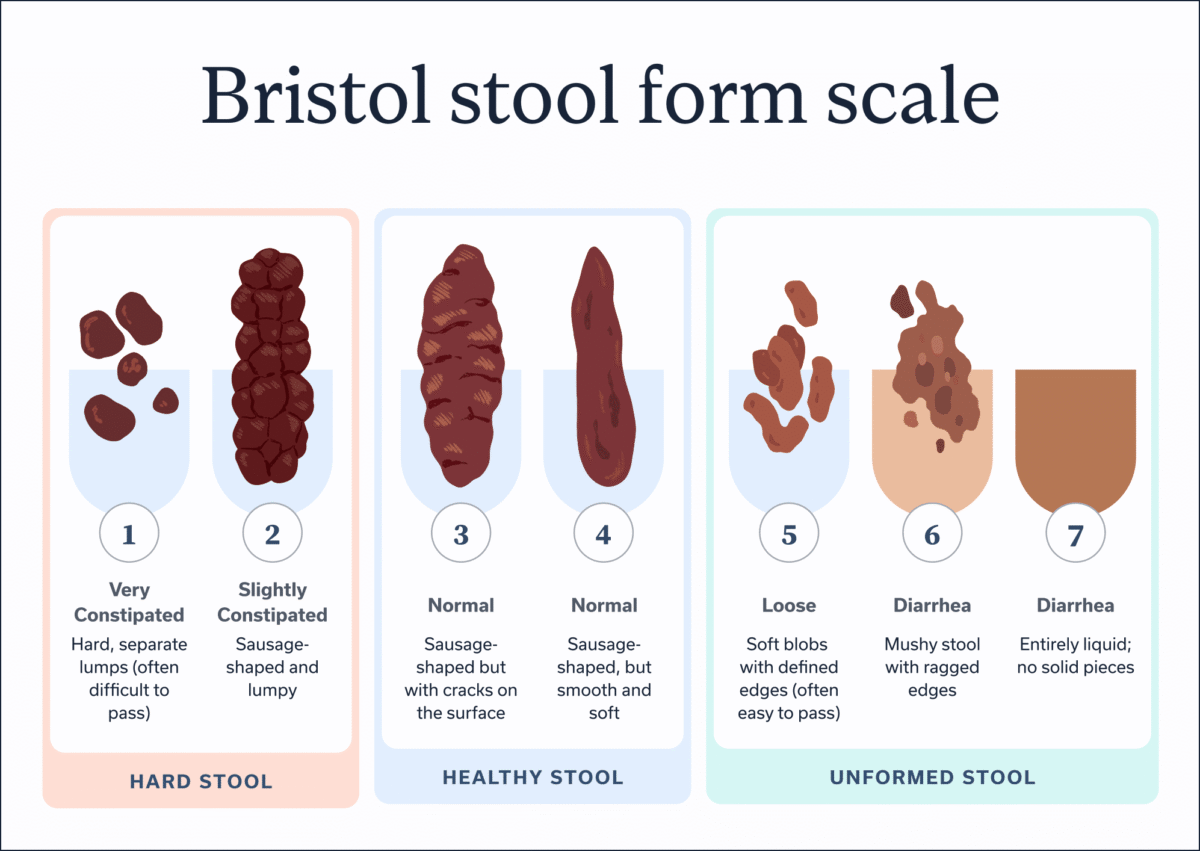
And while it’s important to note any sudden changes in how often you go, your poop’s appearance also provides clues about whether your GI tract is working as it should. Looking at your poop probably doesn’t sound like an ideal activity, but it can tell you a lot about your gut health. There’s even a scale, the Bristol Stool Chart, that offers seven common types of stool shapes. Healthcare providers use these types to help determine overall gut health:
- Type 1: Hard, individual lumps that look like nuts
- Type 2: Sausage-shaped but too lumpy
- Type 3: Sausage-shaped but cracked on surface
- Type 4: Looks like a sausage and has a smooth surface
- Type 5: Soft blobs that have clear edges
- Type 6: Mushy pieces with ragged edges
- Type 7: Liquid with no solid pieces
Types one and two are typically classified as constipation, while types five, six, and seven are considered diarrhea or progressing to diarrhea. Types three and four are generally considered normal shapes. The focus should be on avoiding the extremes on the chart (types one and two, and six and seven).
To decide if your bowel movements are normal, a clinician will also ask you about bowel control. When it’s hard to go, the muscles strain, potentially leading to hemorrhoids. But if the muscles in your abdomen and pelvic floor can’t hold back stool as intended, you may have more frequent bowel movements or, worse, might not make it to the toilet in time.
Is it normal to poop 5 times a day?
If five times a day is your baseline, and there are no red flags when it comes to your stool’s form or how easy it is to poop, then it may be normal. If, however, you used to poop twice a day and now find yourself going five times, it may be a flag that things aren’t working as they should
T his is especially true if the change interferes with daily life, work, travel, or causes anxiety about needing to be near a bathroom at all times. Any pattern changes, including pooping more than you used to, are valid reasons to make an appointment with a primary care provider or (ideally) a GI provider.
Pooping a lot but not diarrhea: What this pattern usually means
I’d love to provide one clear reason for what causes increased bowel movements without diarrhea, but there isn’t one. Instead, there is a laundry list of possible causes.
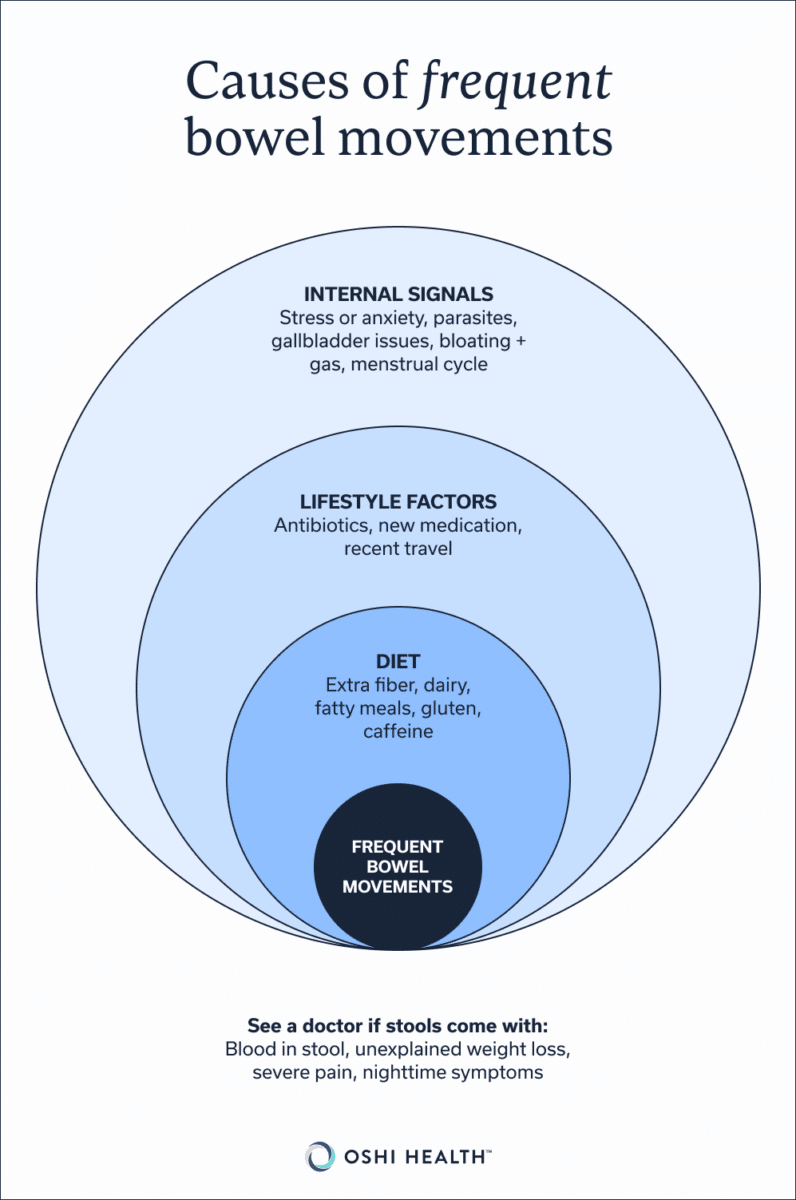
The first thing to look at is your diet. Some foods may speed up your diet, while others slow digestion. To make matters more confusing, healthy foods can fall in either category. Take, for example, fiber. For most people, fiber is part of a healthy diet, but there are two types that have very different effects on digestion:
- Soluble: Dissolves in water and can help slow digestion and produce softer stool.
- Insoluble: Doesn’t dissolve in water and adds bulk to stool. This can help relieve constipation, but in some people, it may worsen stool frequency or urgency.
If you’ve “fibermaxxed” recently and heavily leaned into insoluble fiber sources (which include fruits and veggies with skin, seeds, nuts, and popcorn), you may have to go number two more often as your body adjusts.
A diet high in caffeine, sugar, fat, or spicy foods may also lead to more bowel movements. “Your nutrition status and what you eat can increase the risk for soft stools and diarrhea,” says Shelley Balls, MDA, RDN, LDN, a registered dietitian in Wyoming.
If you’re experiencing more frequent bowel movements but haven’t changed your diet in years, something else is probably going on. Balls says, “If you’re constantly on the toilet despite how much dietary fiber or fluids you consume throughout the day, there is most likely an underlying cause for this.”

Common causes of frequent bowel movements
Remember when I said there were a lot of potential reasons for more frequent bowel movements ? Well, it’s time for the (mostly) complete list of the medical conditions that may cause this.
Digestive conditions and structural issues
Celiac disease or gluten intolerance
A sensitivity to gluten and Celiac disease are not the same thing, though both can impact digestion, which may lead to more frequent bowel movements after eating foods containing gluten.
Gallbladder issues
The gallbladder is a pear-shaped organ that rests below the liver and plays a role in digestion. When someone has gallstones and/or gallbladder disease, it can impact digestion, which may include more frequent bowel movements.
GI bugs
When more frequent bowel movements come on quickly and are accompanied by other sudden symptoms, such as light-headedness, fatigue, and extreme thirst, it could be due to a virus like the stomach flu.
Irritable bowel syndrome (IBS)
IBS is a bowel disorder with multiple subtypes (IBS-C, IBS-D, and IBS-M). IBS-M (mixed) and IBS-D (diarrhea) can both cause bowel movements to become more frequent.
Inflammatory bowel disease (IBD)
IBD, an umbrella term for multiple conditions including Crohn’s disease and ulcerative colitis, can cause a variety of GI symptoms, including increased bowel movements.
Pancreas dysfunction
The pancreas is a gland that produces an enzyme that helps digest food. If there is a problem (often pancreatitis or cystic fibrosis) with the pancreas’s production of that enzyme, it may result in pooping more often than usual.
Pelvic floor issues
If you’re struggling to control bowel movements, it could be due to an issue with the pelvic floor muscles.
Small intestinal bacterial overgrowth (SIBO)
A bacterial overgrowth in the small intestine can disrupt digestion, causing a number of uncomfortable GI symptoms. These might include having to go number two more often.
Hormonal and metabolic causes
Hyperthyroidism
When the thyroid (a butterfly-shaped gland in the neck) produces more thyroid hormones than the body needs, it’s referred to as hyperthyroidism. One of the roles of thyroid hormones is to control the speed of digestion. When the thyroid is overactive, it can disrupt digestion, leading to changes in the bowels.
Menstrual cycle
If you’re pooping more often during that time of the month, it could actually be due to your period. Some of the hormones involved in the menstrual cycle also influence your gut. More specifically, progesterone drops and levels of prostaglandins rise when Aunt Flow visits, which can cause food to move through the GI tract faster.
Lifestyle and other factors
Parasites
Parasites in the digestive system can cause a slew of GI symptoms–abdominal pain, gas, bloating, stomach cramps, and diarrhea. Typically, parasites cause diarrhea (not just passing more stool), but symptoms can vary in intensity, meaning this is a possible, but not likely, cause.
Other food intolerances
Alongside gluten, other food intolerances are also linked to bowel movement changes, such as FODMAP intolerances and lactose intolerance.
Stress and anxiety
Last but certainly not least, stress and anxiety can speed up digestion, which may mean more trips to the bathroom. The reason for this is the gut-brain axis, a two-way street where the brain can send messages to the gut and vice versa. When these messages are stress-inspired, they can have negative effects on your whole system.
Medications
The culprit could also be found in your medicine cabinet. Plenty of medications list more frequent bowel movements as a possible side effect, including nonsteroidal anti-inflammatory drugs (NSAIDs) like ibuprofen, antibiotics, and Metformin, to name a few.
Why am I pooping so much? Clues that narrow it down
Just reading that list of potential causes is overwhelming, much less figuring out which one is the culprit. The good news is, an official diagnosis is a GI provider’s job, not yours. You can, however, collect some clues that may help narrow down the list of suspects:
- Are there any other symptoms? Note any other symptoms you’re experiencing, such as gas, bloating, a weight change, fever, stomach pain, blood in stool, or fatigue.
- When did the increase in bowel movements start? Did bowel movements increase suddenly, such as within a few days, or gradually over the course of weeks or months?
- Have there been any stool shape changes? Refer back to the Bristol Stool Chart. What type do your bowel movements look like? It’s ok if you’re torn between a few; jot them down.
- When do bowel movements tend to occur? Look at when bowel movements tend to occur. Are they in the mornings, all day, after a meal, or at night?
- Are there any new triggers that are causing me to go number two? Think over the last few weeks. Have you introduced any new habits, foods, medications, or supplements that may have impacted gut health?

Diagnosis: How clinicians evaluate frequent bowel movements
As we’ve mentioned, putting on your detective hat and collecting clues is important, but it’s not a replacement for seeing a qualified healthcare provider. Ideally, that’s a GI provider, though you may be able to start with a primary care provider and go from there.
And the best time to meet with them? “I recommend sooner rather than later,” says Balls, “to help you get back to eating the foods you enjoy without the stress of where the nearest toilet is at all times.”

On the day of your appointment, come armed with any clues you’ve collected. A GI provider will also ask about your medical history, including what bowel movements usually look like for you, any recent travel, additional symptoms, what medications you take, and if you’ve made any recent dietary changes. From there, they’ll order any necessary labs and may order a stool test.
Treatment options: What helps depends on the cause
“Treatment options really depend on what the root cause of your frequent stools is,” says Balls. For example, probiotic-rich foods may help some people regulate their bowel movements, but if symptoms are SIBO-related, probiotic-rich foods may make symptoms worse.
Depending on the cause, your treatment plan may include medications, working with a GI registered dietitian to tweak your diet, or collaborating with a gut-brain specialist or therapist on ways to reduce stress.
In the meantime, Balls recommends looking at your day-to-day habits. She explains, “Some habits you can start right now to promote your gut health are to prioritize your sleep, reduce your stress, exercise regularly, and focus on food quality and appropriate portion sizes.”
While many of these steps are more effective with the help of a GI provider, creating a calming evening routine, going on a twenty minute walk (this could be on the treadmill for easy bathroom access), or reducing the amount of ultra-processed foods you eat (i.e. pastries, chips, fried food) can be a solid first step ahead of that GI appointment.
Working with a healthcare provider
When bowel movements change, there are a lot of things that could be going on. That’s why it’s important to work with a GI provider who assesses the dietary, medical, and mental health factors that may cause more frequent bowel movements. A multidisciplinary approach can provide much-needed support and answers.
At Oshi Health, our multidisciplinary care team uses a whole-person approach for any and all symptoms. That means you’ll work with a care team that may include a GI provider (a gastroenterologist, nurse practitioner, and/or physician associate), a GI registered dietitian, and/or a gut-brain specialist. Together, they’ll create a treatment plan that addresses gut health from every angle.
Key takeaways
- If you’re pooping a lot but you’ve ruled out diarrhea, there are probably a few questions rolling around in your head, including why this is happening, if it’s a cause for concern, and what you can do to stop it.
- There are various reasons why someone may be pooping more than usual. They range from dietary changes to medical conditions, like hyperthyroidism and IBS, to stress and certain medications and supplements.
- The best way to determine the exact cause and get your bowel movements back to business as usual is to work with a GI provider, such as the team at Oshi Health.
- Any time there’s a noticeable change in your bowel movements, it’s worth consulting a healthcare specialist. This is especially true if that change gets in the way of life, work, travel, or even just makes you more anxious about whether a bathroom is nearby.
Frequently Asked Questions (FAQs)
-
If you’re pooping more than you usually do, there are many potential causes. Medical conditions, like IBD or Celiac disease, may cause changes to bowel movements, as can stress, travel, medications, supplements, and dietary adjustments. Discovering the exact reason often requires working with a GI provider, such as the team at Oshi Health. They can assess symptoms and provide a tailored treatment plan.
-
There are many reasons someone might have frequent bowel movements without diarrhea. Sometimes, pooping more than usual stems from travel, a change in diet or hydration, or increased stress. Other times, it’s from a medical condition or as a side effect of a medication or supplement. Many conditions may result in bowel movement changes, including anxiety, hyperthyroidism, IBS, IBD, Celiac disease, gallbladder issues, and more. If the increase in bowel movements occurs around the same time each month, it could be due to your menstrual cycle.
-
Unhealthy poop can look like small, hard lumps or a watery substance with no solid pieces. The former indicates someone may have constipation while the latter is often a sign of diarrhea. In contrast, healthy poop is often sausage shaped with defined edges and a mostly smooth surface.
-
The feeling of always needing to poop could be due to dietary changes, such as eating more fiber than usual or drinking a lot of caffeine, an underlying medical condition, like IBS or IBD, or even being more stressed than usual. A GI provider, such as the team at Oshi Health, can help you determine what’s causing this urge.
Oshi is your partner in digestive health
Feel like your digestive concerns are running your life? You’re not alone—and we’re here to help you find lasting relief.
Oshi Health GI providers, gut-brain specialists, and registered dietitians work together to address your symptoms and find solutions that actually work for you.
Whether you’re dealing with chronic digestive issues or unpredictable symptom flare-ups, our GI specialists deliver:
✔ Personalized care plans tailored to your lifestyle
✔ Science-backed strategies to calm your gut
✔ Compassionate, whole-person care
✔ And so much more!
Ready to take control of your gut health?