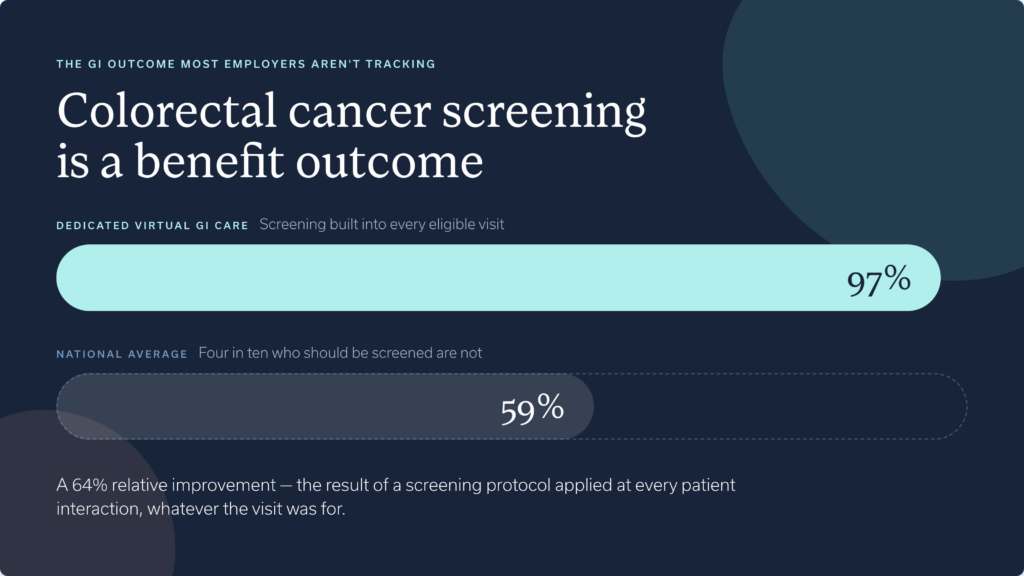
Oshi Health has analyzed outcomes data to answer the questions that matter most to purchasers: do results hold at scale, do they hold across diverse populations, and do the cost savings materialize in real employer and payer claims data?
Most digital health programs publish outcomes data from a few hundred patients in a controlled trial. That is enough to establish proof of concept but it is not enough to answer the questions that matter most to purchasers: do results hold at scale, do they hold across diverse populations, and do the cost savings materialize in real employer and payer claims data rather than just clinical self-reports?
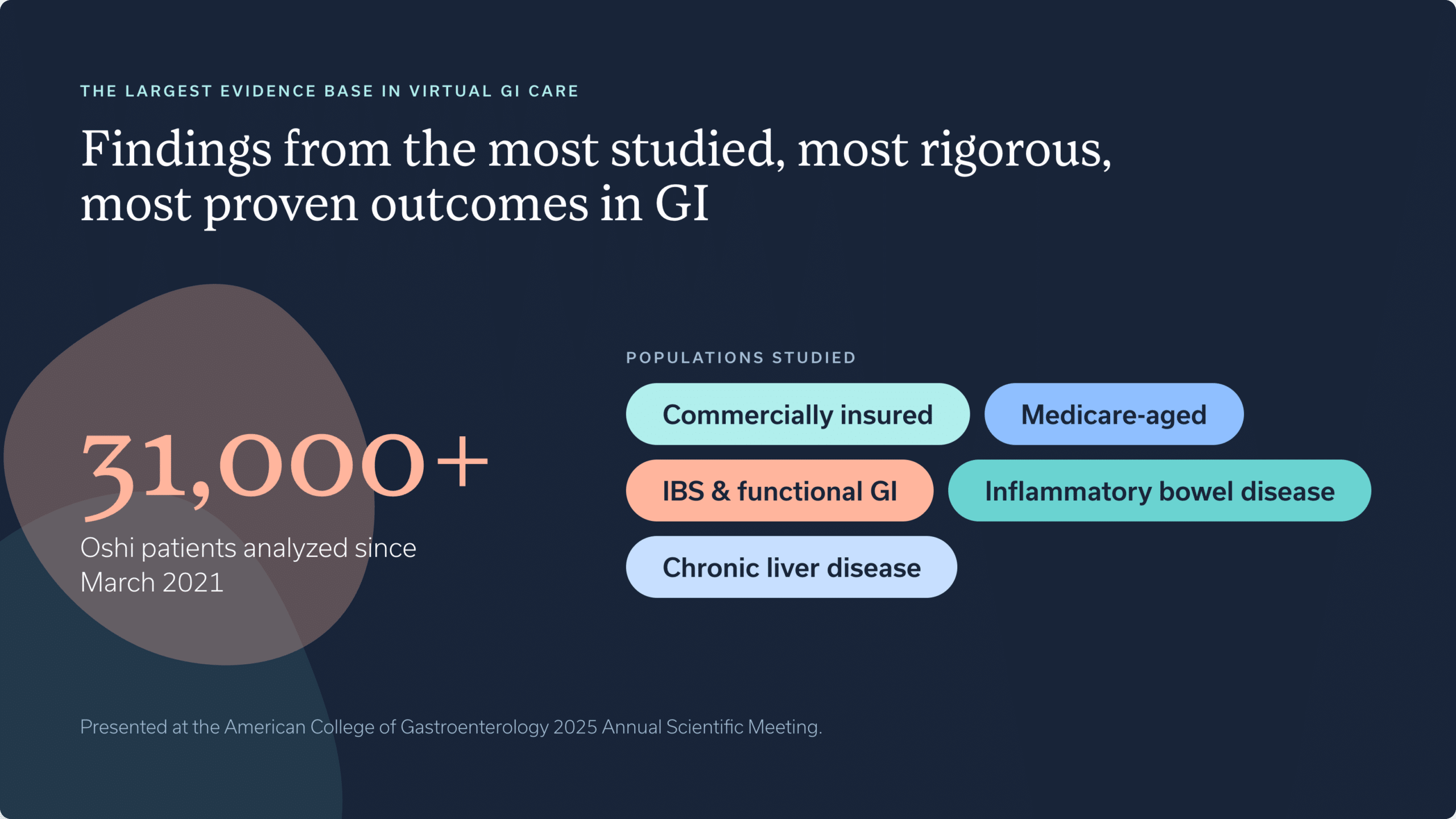
Since launching in March 2021, Oshi Health has analyzed outcomes data from more than 31,000 patients across commercial, Medicare-aged, IBD, IBS, and liver disease populations. The findings are consistent: Outcomes replicate across profiles, in real-world patient populations.
What the data shows across populations
In Oshi’s 2025 national payer study, covering 5,739 commercially insured patients, a propensity-matched claims analysis conducted by a national payer found 97% patient satisfaction, 90% symptom control, 68% reduction in GI-related emergency visits, and $6,081 in overall per-member cost savings annually.
In an employer cost analysis covering 510 patients, all-cause medical cost savings reached $10,984 per member, with a return on investment of 9.99 and an 8.4% decline in GI-related PMPM population spend.
Outcomes hold across condition types
In a focused study of 356 Medicare-aged patients, symptom control reached 95% with 100% patient satisfaction.
In a study of 323 patients with chronic liver disease, symptom control reached 86% with 100% patient satisfaction.
In an IBD-specific study, 85% reduction in avoidable GI-related ED visits was documented alongside $16,751 in all-cause healthcare cost savings per member, a return on investment of 22.51.
These results, presented at the American College of Gastroenterology 2025 Annual Scientific Meeting, reinforce that the model is not optimized for a narrow patient profile. It works across the full spectrum of GI complexity.
What consistent results at scale actually mean
The significance of consistent outcomes across 31,000 patients answers the question every purchaser eventually asks: will this work for my population?
Employer populations are not homogeneous. They include patients with simple functional GI conditions and patients with complex, chronic inflammatory disease. They include patients with complex comorbidities – especially mental and behavioral disorders, endocrine, cardiovascular and metabolic conditions. They include employees who have never sought GI specialty care and employees who have cycled through the system for years. Only a program that produces strong outcomes across the full spectrum will generate population-level cost impact.
Chantell Sell, who leads the digestive health working group at Willis Towers Watson, summarized the reaction among the consultants who review this evidence base closely: if this were a clinical trial for a drug, she said, it would be a blockbuster.
The evidence base behind virtual multidisciplinary GI care is now large enough and rigorous enough to support confident purchasing decisions. The question is no longer whether the model works. It is whether your population knows they have access to it.