Published in the Journal of Medical Internet Research (JMIR), study spanning all 50 states finds team-based virtual GI care delivers significant symptom improvement, with dietary and behavioral health engagement as key drivers of outcomes
A peer-reviewed study published in the Journal of Medical Internet Research (JMIR) shows that 92.4% of 11,345 patients reported symptom improvement after receiving virtual multidisciplinary GI care from Oshi Health.
The study, which represents patients across all 50 states and D.C. from April 2021 to August 2025, is the first of its scale to show the extent of patient engagement in virtual multidisciplinary care and sheds light on why integrated care works. It found that GI provider engagement drove an increased utilization of registered dietitian and behavioral health services, which in turn was associated with significantly greater symptom improvement. Patients with four or more total appointments had a 92.4% probability of symptom improvement, compared to 69.6% among those with only two or three total appointments.
“This is the largest study of virtual multidisciplinary GI care ever published, and the results show that this model is highly effective at controlling symptoms in real-world populations, patients are highly satisfied, and clinician-led care can be delivered at a national scale,” said Sameer Berry, MD, MBA, chief medical officer and co-founder of Oshi Health. “GI conditions are among the most prevalent and costly in the U.S., yet most patients can’t access the integrated dietary and behavioral health support that evidence shows they need. This study demonstrates that virtual care can close that access gap while delivering outcomes that rival what in-person multidisciplinary care has achieved in smaller randomized controlled clinical trials.”
"The findings from this study are significant for the field. We've known from clinical trials that multidisciplinary care produces better outcomes for GI patients than standard gastroenterology alone. What this study demonstrates is that you can deliver the same integrated approach virtually at a national scale and achieve meaningful results for a diverse patient population. For the millions of Americans living with chronic GI conditions who can't access multidisciplinary care where they live, that matters enormously."
— William D. Chey, MD, chief of gastroenterology at the University of Michigan and co-author of the study
Key findings from the study include:
- 11,345 patients received virtual multidisciplinary GI care across all 50 states
- 92.4% reported symptom improvement; 89.8% reported symptom control
- 95%+ reported symptoms posed minimal to no disruption to daily life after care
- Median time to first appointment: 6 days (compared to 40-day average for in-person GI visits)
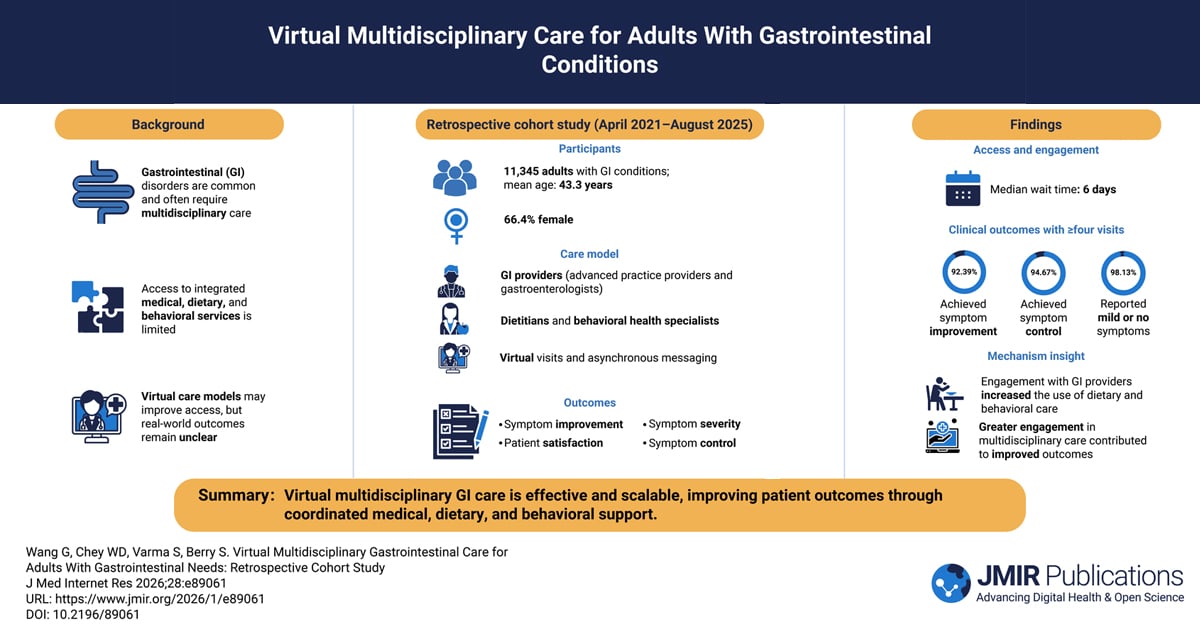
Virtual Multidisciplinary Gastrointestinal Care for Adults With Gastrointestinal Needs: Retrospective Cohort Study
A peer-reviewed study in the Journal of Medical Internet Research (JMIR) shows that 92.4% of 11,345 patients reported symptom improvement after receiving virtual multidisciplinary GI care.